
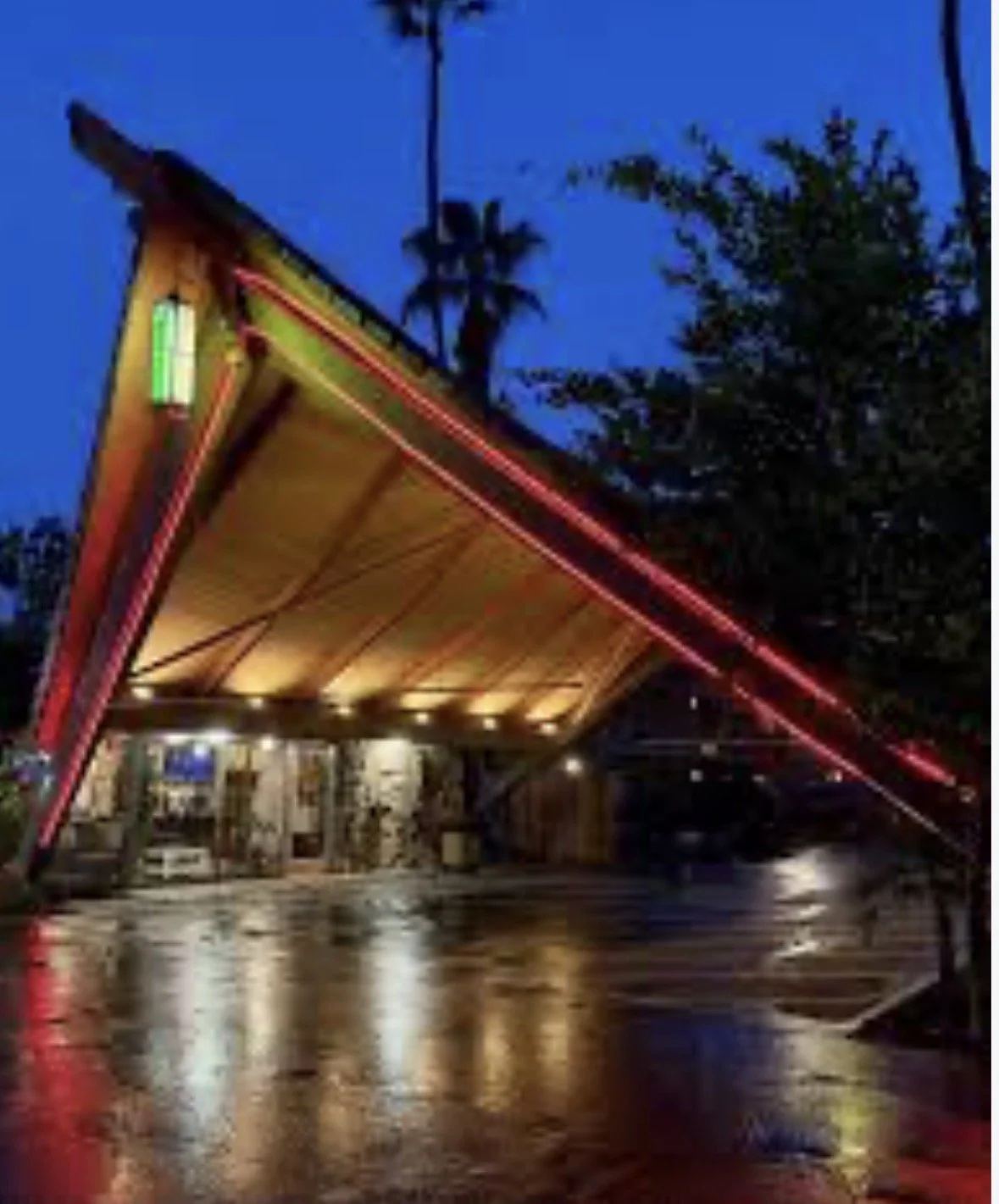
Caliente Tropics Hotel, Palm Springs
Welcome to Palm Springs Tiki, Part Three
You can find the previously published Parts One and Two of this Tiki Trilogy Series here in our food and culture journal called Devour the Desert.
There Was, Eventually, a Problem With All of This Fantasy
It worked.
Donn Beach had created an imaginary tropical world in Hollywood, and Americans liked it. Trader Vic had figured out how to make the idea portable, repeatable and profitable. Tiki bars began appearing across the country, bringing bamboo, rattan, carved gods, exotic cocktails and the vague promise of Polynesian adventure to places that were otherwise considerably closer to Cleveland than Bora Bora.
And then there was the inevitable next step.
Everybody wanted one.
With a Tiki bar seemingly in every suburban rec room, the exotic was no longer exotic.
This is what happens to almost everything we fall in love with.
First somebody invents it. Then somebody discovers it. Then somebody copies it. Eventually somebody figures out how to sell a mass production version.
And once everybody has it, we decide it is hopelessly passé.
Tiki was no exception.
Paradise, Mass Produced
At its height, Tiki was everywhere.
There were Polynesian restaurants in cities that had never seen a palm tree outside a postcard. There were hotel bars, suburban restaurants, bowling alleys and lounges decorated with bamboo and thatch. There were flaming drinks, elaborate ceramic mugs and menus that offered dishes with names that probably sounded more exotic in 1957 than they do now.
The original idea had been escapism.
Now escapism had a franchise.
And the more successful Tiki became, the more diluted it became. The cocktails were simplified. The décor became predictable. The exotic became a collection of familiar clichés: bamboo, palm trees, carved faces, ukuleles, volcano bowls.
What had once been a strange and sophisticated form of theater could become, in less capable hands, something resembling a Polynesian-themed restaurant designed by a man who had once seen a postcard from Hawaii.
This wasn't Donn's fault, exactly.
It was success doing what success does.
Once enough people copy an idea, the copies become more visible than the original.
Eventually the original disappears beneath them.
Then We Got Tired of It
By the 1970s, Tiki had begun to look old-fashioned.
America had changed. Tastes changed with it. The sleek optimism of the postwar years had given way to something less interested in pretending that every evening could be a tropical vacation.
The old Tiki bars began closing.
Some were demolished. Some were remodeled into ordinary restaurants. Some simply faded away.
And the things that had once seemed exotic became kitsch.
This is worth noting.
Kitsch is not necessarily bad art.
It is often something we have become too familiar with to take seriously.
The Tiki bar had become so thoroughly absorbed into American popular culture that its original magic had become difficult to see.
We knew the jokes.
We knew the drinks, the coconut mugs and the bamboo.
And once we knew the trick, the trick stopped working.
Then Something Strange Happened
A few decades later, people started looking again.
Bartenders began digging through old cocktail books and trying to reconstruct the drinks Donn Beach and Trader Vic had created. Collectors started hunting for vintage mugs. New bars appeared that treated the old recipes seriously instead of drowning them in fruit juice and novelty.
The old places became objects of fascination.
What had once been dismissed as kitsch began to look like something else: craftsmanship.
The drinks were complicated because somebody had thought carefully about them. The rooms were elaborate because somebody had thought carefully about the experience. The absurdity was deliberate.
Tiki had not really disappeared.
It had been waiting for somebody to take it seriously again.
And perhaps that is why the current Tiki revival feels different from the Tiki boom of the 1950s and '60s.
The new generation knows that the old thing was invented. They just don't care.
They are perfectly happy to enjoy the re-invention.
We Do This All the Time
Tiki is hardly unique.
American culture has a peculiar habit of falling in love with something, exhausting it, throwing it away and then rediscovering it thirty years later.
Midcentury modern followed almost exactly the same path.
In the beginning, it wasn't a decorating style. It was a new way of living.
The houses were designed around indoor-outdoor living. Walls opened to gardens. Glass brought the landscape inside. Furniture was designed for the modern age. Materials that had once belonged to factories found their way into homes.
It was new.
Then it became fashionable.
Then everybody wanted it.
Then it became dated.
For a while, a midcentury house was something you might improve by removing the very things that made it midcentury.
People covered terrazzo floors. They enclosed patios. They remodeled kitchens until the houses looked like every other house built in the previous twenty years.
And then another generation came along and looked at the same houses and thought:
Wait.
This is actually fantastic.
The terrazzo came back.
So did the furniture.
So did the flat roofs.
So did the appreciation for the very things that had once been considered hopelessly out of date.
The old fantasy had become new again.
Palm Springs Did It Too
Which brings us, inevitably, to Palm Springs.
The city itself has lived through this same cycle.
There was a time when Palm Springs was the glamorous playground of Hollywood.
Sinatra was here. The Rat Pack was here. Movie stars came to disappear for a weekend without having to disappear very far.
Then the culture changed.
Palm Springs became less fashionable. The old glamour faded. Some of the hotels struggled. Some of the houses were altered or neglected. The city that had once represented modernity began to look like a place whose best years were behind it.
And then Palm Springs was rediscovered.
But something interesting happened. The city didn't simply restore its past.
It reinterpreted it.
The midcentury houses became desirable again. The old hotels became fashionable. Vintage furniture became collectible. Cocktail culture returned. And Tiki returned.
The things that had once made Palm Springs look old suddenly made it look new.
There is something wonderfully strange about this.
A city can spend twenty years trying to become more contemporary, only to discover that the thing people actually want is the version of the city it was trying to get away from.
Perhaps that is why Palm Springs has such a powerful relationship with nostalgia.
We don't simply preserve the past here.
We keep finding new uses for it.
I Didn't Know Any of This
I certainly didn't know any of this when I was a kid.
Here is what I do know: my family went to Trader Vic's in Chicago on one occasion. The afternoon still stands out in my memory, exotic and wonderful through the eyes of this child.
I was transported to a magical world beyond my imagination. It felt like Swiss Family Robinson, a popular Disney film from my childhood, but with brighter colors and cocktails that looked and behaved like small volcanoes.
The beverages were theatrical, whimsical, cinematic. They looked like fun in a glass, deceptively innocent in their bright colors.
In no time, my fun-loving and chatty but always sensible mother was the life of the party. Everything had suddenly become quite hilarious to her. The tiny paper umbrellas became airborne, twirling like little helicopters, or were inverted to become spinning tops on the table, and the tropical flowers that had garnished the drinks now migrated around the table, to be tucked behind ears or threaded through buttonholes.
The nearby tables took note. We didn’t care. This was fun.
I had never seen her this way. There was something deliciously illicit about watching my mother become progressively more tipsy and silly while sitting in a restaurant that seemed to have been transported from somewhere on the other side of the world.
Perhaps my father took note, too. This was the serious, hardworking Midwest after all. Too much fun was always suspicious.
We never returned. My one journey into the exotic world of Tiki was over.
At the time, I had no idea that Trader Vic's was part of a cultural story that had begun in Hollywood more than thirty years earlier.
I didn't know who Donn Beach was. I didn't know that Victor Bergeron had borrowed an idea and turned it into an empire.
I didn't know that the room around me was an elaborate piece of theater.
I just knew it was fun.
The Trick Still Works
That is perhaps the oddest thing about all of this.
We know the trick now.
We know that the bamboo isn't from the South Seas. We know that the rain is coming from a garden hose. We know that the cocktail was invented in California. We know that the character behind the bar is, in all likelihood, not quite the person he claims to be.
And yet we still go.
Apparently we never get tired of being transported into a fantasy.
And somewhere in Hollywood, in 1933, Donn Beach figured that out.
The rest of us have been happily paying admission ever since.
Enjoyed this article? Explore more of our "Local…" series to discover the Palm Springs stories that helped shape the desert's singular character. You'll find collections devoted to food, architecture, celebrities, history, culture and the people who continue to make Palm Springs unlike anywhere else.
At Artisan Food Tours, we spend our days walking Palm Springs neighborhood by neighborhood—through mid-century streets, experiencing the history and the daydreams that hide behind unassuming doors.
Some of those stories involve architects. Some involve Hollywood.
And some involve rum, torches, and a city that decided the South Pacific would look perfectly fine beside the San Jacinto Mountains. We love this idea so much we decided to offer a custom Tiki drink and food tour option.
Want to experience a little of that magic for yourself? Join us on an Artisan Food Tours walking tour and discover Palm Springs one memorable bite, sip, and story at a time. Come hungry. We’ll handle the rest.
Dave Ball is a local tour guide and co-owner of Artisan Food Tours with his wife, Phyllis. He spends an inordinate amount of time thinking about Palm Springs history, neighborhood architecture, and where to find a great meal. His reigning food obsession remains local Deglet Noor dates with Fix & Fogg Crunchy Peanut Butter, though a Bootlegger Painkiller has lately been vying for the title. Stay tuned for this rapidly developing story.