
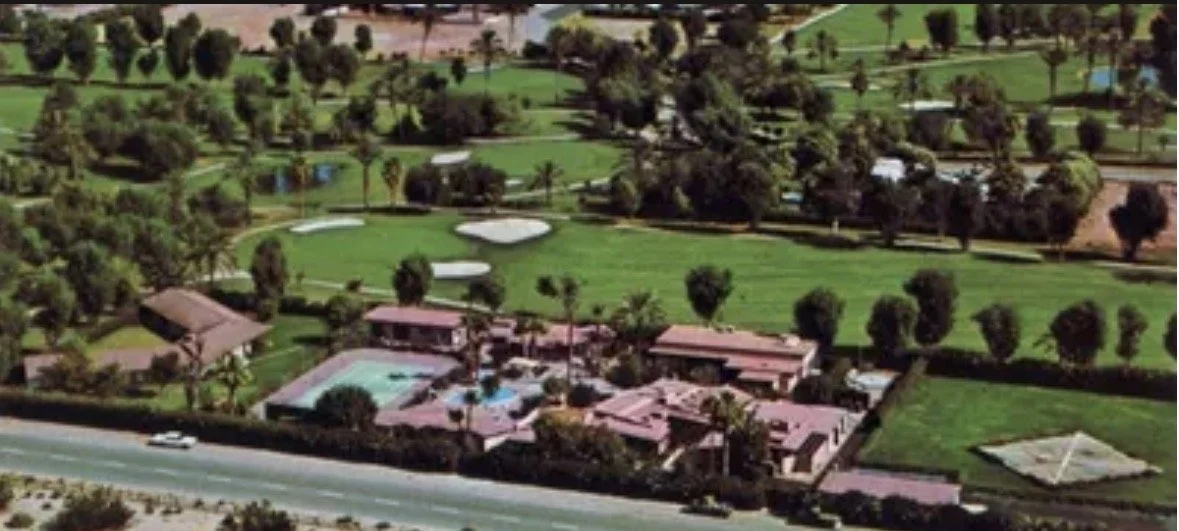
Sinatra Compound at Tamarisk Country Club
Inevitably, as a local tour guide, there are unexpected questions that come my way.
Some are wonderful observations, some indicate deep thinking about this unique place and some make me wonder if the guest just returned from an ayahuasca retreat at Joshua Tree.
Examples:
Why are the mountains so close to town?
Because we grew up together and are still very good friends.
Do people actually live here?
No, we’re all paid actors and this is one big stage set.
Is everybody here on permanent vacation?
See answer above. We only get paid scale, but it covers the nut.
And then there are the questions that seem simple until you start thinking about them.
Do people who live here miss having four seasons?
Why is my phone not working?
Why did Sinatra choose Tamarisk Country Club for his home?
I’ve researched the second set of questions, notwithstanding the lack of grant funding.
So please consider this my public-service gift for the betterment of Palm Springs.
You can thank me in person when I finally receive my star in the sidewalk and the city declares Dave Ball Day.
Do people who live here miss having four seasons?
We do have four seasons.
We call them:
Spring
Summer
Extra Crispy Summer
and
What the Hell Were You Thinking?
Spring is lovely. Summer is hot. Extra Crispy Summer is when your car's steering wheel becomes a weapon. What the Hell Were You Thinking? is reserved for anyone who books a Palm Springs vacation in August because they found a really good hotel rate.
And then, sometime around October, the place remembers how to be civilized.
We're back in Spring, but with shorter days.
People come outside.
Restaurants fill up.
The tourists return.
And locals begin saying things like, “It's only 87 today,” with the same satisfaction someone in Chicago might reserve for the first warm day in April.
So we don't actually lose the seasons. We just redefine them.
There is a hunker-down season, certainly. But it lasts only a few months, leaving roughly nine months of the year when you can eat outside, walk around without tempting the Grim Reaper, and wonder why anyone would willingly live somewhere that requires a snow shovel.
It's not a bad trade.
Why is cell phone reception so sketchy around here?
This one required slightly more research than I was hoping to devote to the question of why my phone occasionally becomes a decorative rectangle.
Spotty cell service and calls dropping mid-sentence are a fact of life here. Don’t take it personally. It’s not you. It’s all of us.
I am not aware of a secret cabal involving the phone companies and city hall devoted to making you say, “Can you hear me now?”
But I also can't rule it out.
This is Palm Springs, and strange things have been known to happen.
Part of the problem is geography. As I mentioned, we have a close relationship with the mountains, and radio signals do not particularly enjoy travelling through large quantities of rock. Coverage can also vary dramatically from one street to the next depending on your carrier, the buildings and where somebody decided to put an antenna.
And apparently this isn't entirely in our heads.
Rancho Mirage has actually undertaken a wireless-coverage assessment after residents reported dropped calls despite carrier maps showing substantial coverage. The city has been mapping actual wireless performance, which means that somewhere in the Coachella Valley, someone is being paid to scientifically determine why your phone doesn't work.
I find this reassuring.
So if you're standing outside a restaurant in downtown Palm Springs and your phone suddenly stops working, there is a perfectly reasonable explanation.
You may, however, want to stop walking around in little circles while holding it above your head.
I tried this in the 1990s.
It still doesn’t help.
Why did Frank Sinatra choose Tamarisk Country Club for his home?
There should be a simple answer to this, right?
I’ve been looking into it for years now. There is an answer that is more complex and nuanced, turning into a discussion about golf, Hollywood, religion, race and the peculiar social geography of 1950s Palm Springs. It also has something to do with Sinatra’s complicated personal life.
Frank loved Palm Springs, liked golf and had Jewish and Black friends, crossing racial and religious boundaries that were still very much in place at the time.
He first began visiting Palm Springs in the 1940s and built Twin Palms, his famous house on East Alejo Road, in 1947. By 1954, he had moved east to Rancho Mirage and purchased a house overlooking the 17th fairway at Tamarisk Country Club.
He and Ava Gardner had separated that year; their divorce would not become final until 1957.
Tamarisk was founded in 1952 by Los Angeles business investors, many of them Jewish, at a time when discriminatory membership policies were common at private clubs.
The club was conceived in part as an alternative to the exclusionary practices of other clubs in the area and quickly became a gathering place for Jewish entertainers and other prominent figures from Hollywood.
Sinatra was not Jewish, but he was very much part of that Hollywood orbit.
The founding membership included George Burns, Jack Benny, Danny Kaye and four of the five Marx Brothers.
Who wouldn't want to belong to that club?
Harpo Marx even practiced his naked golf game there, apparently without causing much alarm.
This was a different Palm Springs.
And then there was the golf.
Tamarisk had serious golf credentials. Ben Hogan was its first head professional, which is roughly the equivalent of opening a neighborhood swimming pool and having Michael Phelps handle the breaststroke lessons.
Sinatra played plenty of golf, although greatness at the game was apparently not a prerequisite for his enjoyment. He seems to have particularly enjoyed the social side of it.
Tamarisk gave him a rare combination: privacy, golf, Hollywood friends and a club that was, in important respects, unlike many of the private clubs of that era.
Sinatra made the Tamarisk house his desert home for more than four decades. In February of 1995 he performed his final concert at the J.W. Marriott in Palm Desert.
His health was declining, and Barbara convinced him that it was time to move to Beverly Hills, where they could be closer to family and medical care. Frank was reluctant to leave.
After the compound was sold that spring, he remained there as a guest for several weeks, before finally making the drive out for the last time. He died in Beverly Hills three years later.
Today, the road that runs past Tamarisk Country Club—and Sinatra’s former home—is named Frank Sinatra Drive.
Want to ask a few questions in person? Join us on an Artisan Food Tour and come explore the food, history, architecture and characters that make Palm Springs such a wonderfully peculiar place.
Dave Ball is a local guide and co-owner of Artisan Food Tours with his wife, Phyllis. He spends an inordinate amount of time thinking about Palm Springs history, neighborhood architecture, where to find a great meal—and, increasingly, why visitors ask the questions they do. He writes Devour the Desert, a Palm Springs food and culture journal, when he isn't leading tours or wondering why the traffic light is still red.