
Local Questions, Vol. 12 | Field Notes From Palm Springs: Getting in Hot Water, Bears and Other Matters of Great Concern
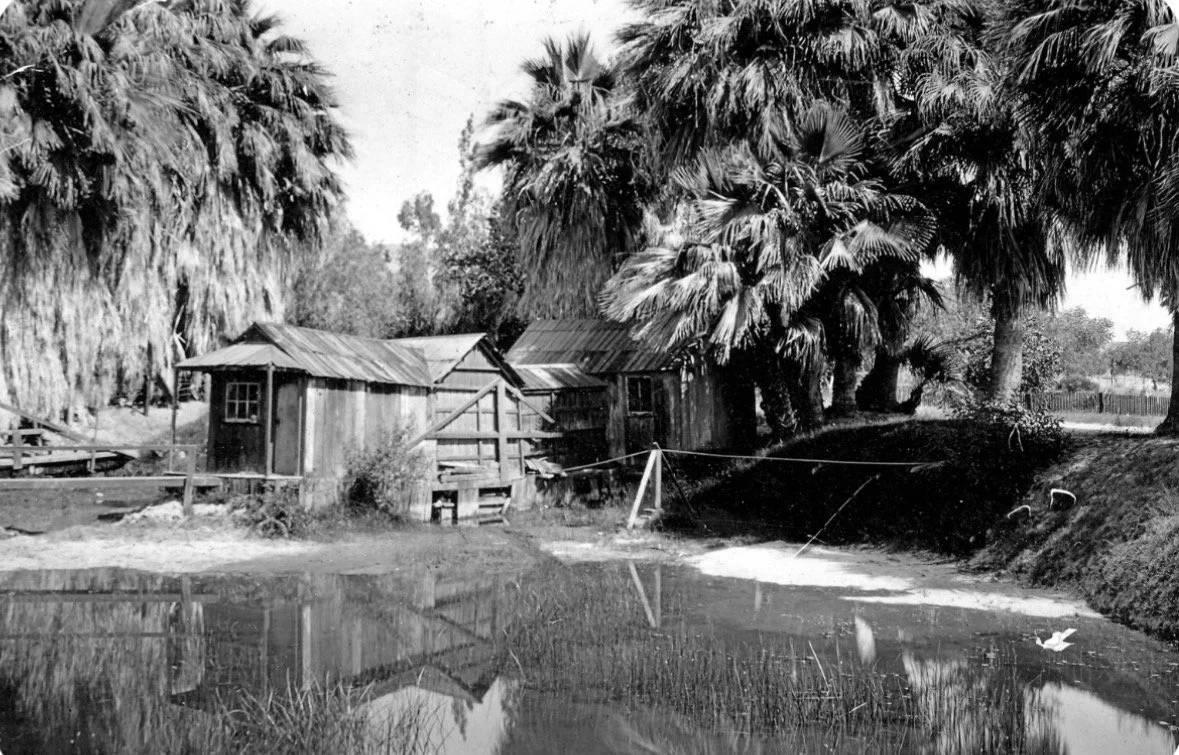
The Agua Caliente hot spring, known as Sec-he, in the early days.
Congratulations.
You've been in Palm Springs long enough now to realize that the questions keep on coming.
And, as we peel back the layers, maybe they also get more interesting.
And concerning…
Welcome to Volume 12, our next edition of the Field Notes series.
Today, we're getting ourselves in hot water with our first question. Let's jump in. Or better yet, ease in... no telling how hot things will get.
Is there really still a hot spring downtown?
Can I see it?
Should I stay in Palm Springs—or somewhere else?
What happens when everyone gets tired of Midcentury Modern?
And, perhaps most importantly, are there bears up there?
Let's take them one at a time.
Is There Still a Hot Spring in Downtown Palm Springs?
Yes.
That's not a metaphor.
The hot spring that gave Palm Springs its name is still here, quietly bubbling beneath the city.
For thousands of years, the Agua Caliente Band of Cahuilla Indians have known these springs as a place of healing and gathering. The Agua Caliente people called the ancient mineral springs Séc-he, meaning "sound of boiling water."
Spanish explorers eventually called the people and the place Agua Caliente—literally, "hot water."
By the early twentieth century, Palm Springs had become a resort town largely because people believed soaking in those mineral-rich waters was good for whatever ailed you.
This was before wellness became an industry and before anyone thought to charge $23 for a green smoothie.
The springs are still flowing underground today, but the original surface pool was closed to protect the site during nearby downtown development.
Sorry to disappoint, but you can't just wander through town, find a little pool between the boutiques and restaurants, strip down to your birthday suit and jump in.
I hate it too.
But here's the good part: the way for visitors to experience the water today is at The Spa at Séc-he, the tribally owned spa in the heart of downtown. You'll find the same mineral spring water that has drawn people here for thousands of years, heated naturally deep underground and brought to the surface for visitors to experience.
So yes, Palm Springs still has its hot springs.
They're just dressed better than they used to be.
And they have smoothies on the menu. For a mere $11.
When I Visit, Should I Stay in Palm Springs—or Somewhere Else?
This depends almost entirely on who you are.
If you're interested in history, architecture, restaurants, culture and the particular oddball personality of Palm Springs, stay in Palm Springs.
You'll be surrounded by Midcentury Modern houses, museums, old hotels, celebrity stories, design shops, restaurants, galleries and enough architectural eccentricity to keep you occupied for days.
It's also wonderfully walkable in places, which is increasingly rare in Southern California.
But the Coachella Valley is much larger than Palm Springs.
If your idea of a perfect vacation involves golf, country clubs, resort pools and not seeing another Midcentury Modern butterfly roof for several days, you may be happier farther down the valley.
La Quinta, Indian Wells, Palm Desert, Cathedral City and Rancho Mirage each have their own character, with an especially strong concentration of golf and resort properties. La Quinta has Old Town La Quinta. Palm Desert has El Paseo, the so-called Rodeo Drive of the Desert. Because even golfers occasionally need somewhere to shop.
There really isn't a wrong answer.
It's more a matter of deciding whether you want your vacation to revolve around the desert lifestyle or the Palm Springs story.
If it's the latter, stay here.
And if not, stay "Down Valley" and come here for the day. Check the drive time first. It takes longer than you think.
Either way, we'll keep the stories coming.
No judgment from us.
Although the local expression "Down Valley" does sound a bit condescending, doesn't it?
What Will Happen to Palm Springs When Midcentury Modern Is No Longer in Style?
This is a question we get more often than you might expect. Sometimes it comes from visitors who remember when "Danish Modern" was all the rage back in the 1960s.
The short answer is: Palm Springs will survive.
Midcentury Modern has been remarkably good to Palm Springs. It gave the city a recognizable visual identity, turned architects into celebrities and transformed a collection of 1950s houses into something people will fly across the country to photograph.
But Palm Springs wasn't invented by Midcentury Modern.
The city was here before architects Richard Neutra and Albert Frey arrived. Before William Krisel drew a thousand desert houses. Before Palm Springs became the capital of Instagram architecture.
It was already a place with a remarkable indigenous history, Hollywood history, architectural history, and a unique relationship with celebrity, leisure and the desert.
And that's the interesting part.
Styles change.
Stories don't.
At some point, Midcentury Modern may become less fashionable. Someone, probably a social media influencer, will declare that terrazzo has had its moment. People will suddenly pretend they don't like kidney-shaped pools. White will become plain vanilla. There may even be a brief and confusing period when everyone wants Tuscan villas again.
Palm Springs will still be here.
And underneath all that architecture is a much bigger story.
We keep reinventing ourselves here.
That's the story worth sticking around for.
Are There Any Bears in the San Jacinto Mountains?
Yes—but probably not where you're imagining them.
There’s not a resident population of bears.
But black bears wander through the San Jacinto Mountains searching for food.
Not dissimilar to our tourist population in Palm Springs.
And before you start scanning the hiking trails for a large furry creature, there's an important distinction: black bears don't actually have to be black.
They can be brown, cinnamon or even blondish.
Which seems unnecessarily complicated for an animal that already has a perfectly good name.
Bears are much more commonly associated with the higher elevations and forested areas on the western side of the mountains. The desert-facing eastern side around Palm Springs is hot, dry and generally not the sort of place a bear would choose for a relaxing afternoon.
So if you're riding the Palm Springs Aerial Tramway and suddenly spot something large and brown that appears to be moving among the trees, it could be a bear.
Or it could be a very committed shrub.
Either way, keep your distance.
And maybe don't bring a picnic basket.
Enjoyed this article? The Local Questions are just one part of Devour the Desert. Explore our other "Local…" series for stories about the food, architecture, history, celebrities, and culture that make Palm Springs unlike anywhere else.
More Desert Questions Coming Soon
The desert is generous with questions.
Why are the mountains different colors?
What’s with the brightly colored doors?
Why do people become oddly passionate about date shakes?
We'll keep asking.
Because around here, curiosity is part of the landscape.
Palm Springs makes more sense when you walk it slowly.
Join us at Artisan Food Tours on a guided food tour and see what the desert tastes like between questions.
Come hungry. Leave like a local.
Dave Ball is a local guide and co-owner of Artisan Food Tours with his wife, Phyllis. He spends an inordinate amount of time thinking about Palm Springs history, neighborhood architecture, and where to find a great meal.
copyright: David W. Ball