
The Local Culture | Joseph Barbera Found a Home in Palm Springs. His Cartoons Still Feel at Home Here.
There are people who come to Palm Springs to escape their work.
And then there was Joseph Barbera.
Barbera was one-half of the team behind Hanna-Barbera, an animation studio whose work is embedded in American pop culture, whether or not we recognize the name.
Tom and Jerry. Yogi Bear. Huckleberry Hound. The Flintstones. The Jetsons. Scooby-Doo. The Smurfs.
It is a rather impressive list for two men who began by making cartoons about a cat trying to kill a mouse.
Barbera was born in New York in 1911, worked briefly in banking—which he reportedly disliked intensely—and eventually made his way to California and MGM. There, in 1937, he met William Hanna. The two became partners, first at MGM and eventually in their own company after MGM shut down its animation department in 1957.
The duo proved to be one of the more remarkable combinations of complementary talent in entertainment.
Barbera was the storyteller and gag man, a skilled sketch artist who could develop characters and situations. Hanna was the production man, concerned with timing, animation and the mechanics of getting the thing made. They had different temperaments, different interests and, as Barbera once put it, remarkably little social life together.
“We never mix socially,” he said. It wasn't deliberate. It just happened.
This may be the most understated description in Hollywood history of a professional relationship lasting six decades.
The two men went on to build what the Television Academy describes as the most successful television animation studio in the business. By the 1970s, Hanna-Barbera had become the dominant force in Saturday-morning television.
The Hanna-Barbera Approach
His cartoons were built around a wonderfully simple trick: take something familiar and push it sideways.
A modern suburban family becomes prehistoric. Or futuristic.
A suburban husband commutes to work in a flying saucer. Or on stone wheels that are powered by the driver's bare feet.
A talking bear steals picnic baskets. A dog solves mysteries.
A cat and mouse spend an astonishing amount of time trying to kill one another while somehow remaining employed.
Barbera and Hanna had actually been doing this sort of thing from their beginning days with MGM. Their first great success was Tom and Jerry, who made their premiere in the 1940 MGM short Puss Gets the Boot. They eventually made 114 Tom and Jerry shorts together, seven of which won Academy Awards.
But television changed everything.
After MGM closed its cartoon studio, Hanna and Barbera figured out how to make animation work on television budgets. Their limited-animation techniques reduced the number of drawings dramatically while putting more emphasis on dialogue, character and visual gags.
It was spectacularly successful.
The Flintstones became the first prime-time animated series to become a major hit. The Jetsons arrived two years later. Then came Jonny Quest, Scooby-Doo, The Smurfs, and many others
Barbera in Palm Springs
Barbera had a place to go when he wanted to get away from all of it.
Palm Springs.
He explained the division of leisure rather neatly: Bill Hanna liked fishing, boating, camping and the great outdoors. Barbera did not. While Hanna went to his ranch, Barbera went to the desert to unwind and spend time with his family.
This seems reasonable.
Palm Springs is in part a fantasy, an illusion—an excellent place to relax for a man who had spent his professional life creating imaginary worlds.
Barbera had a home in Old Las Palmas, the neighborhood that has long been celebrity central for Palm Springs.
And this is where things get interesting.
The Jetsons-Palm Springs Connection
Because if you look at Barbera's cartoons with Palm Springs eyes, you begin to see things.
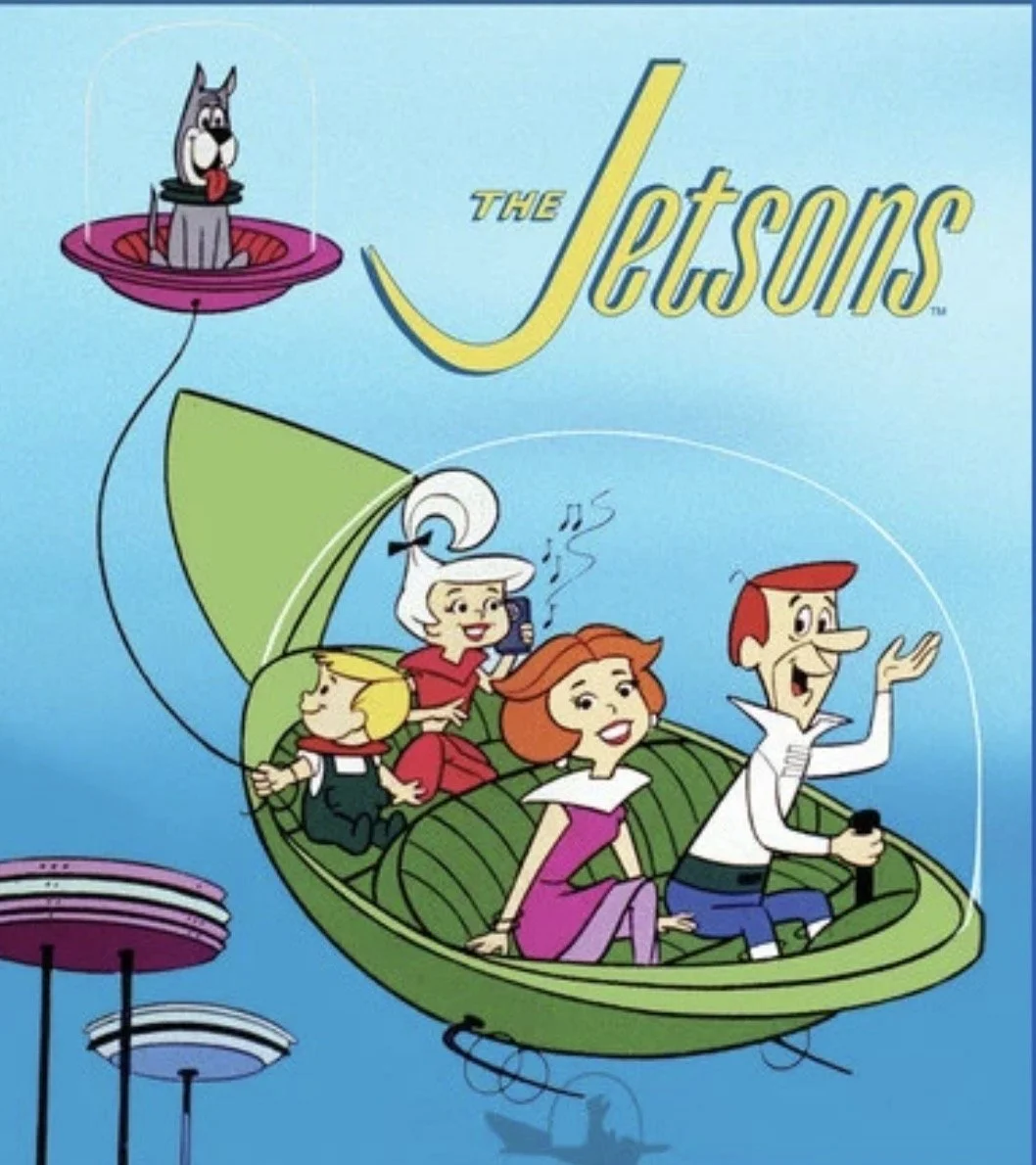
Take The Jetsons, which premiered in 1962. The Jetsons lived in a world of elevated houses, dramatic rooflines, enormous expanses of glass and improbable cantilevers. Sound more than a little like Palm Springs?
The architecture of The Jetsons drew heavily on the Googie architectural vocabulary that surrounded Hanna-Barbera's Hollywood studio: swooping roofs, exaggerated angles, glass, steel and the general conviction that tomorrow was going to be terrific. Architectural historians have pointed to the influence of John Lautner and other midcentury modernists on the show's visual language.
Which makes Palm Springs an even more appropriate place for Barbera to spend his weekends.
We have our own collection of houses that seemed less constructed than launched, including John Lautner's famous “Spaceship House.”
You can look around town and understand how an animator might think in terms of flying saucers, floating roofs and houses that appear to have received instructions from NASA.
The Flintstones-Palm Springs Connection
Then there is The Flintstones.
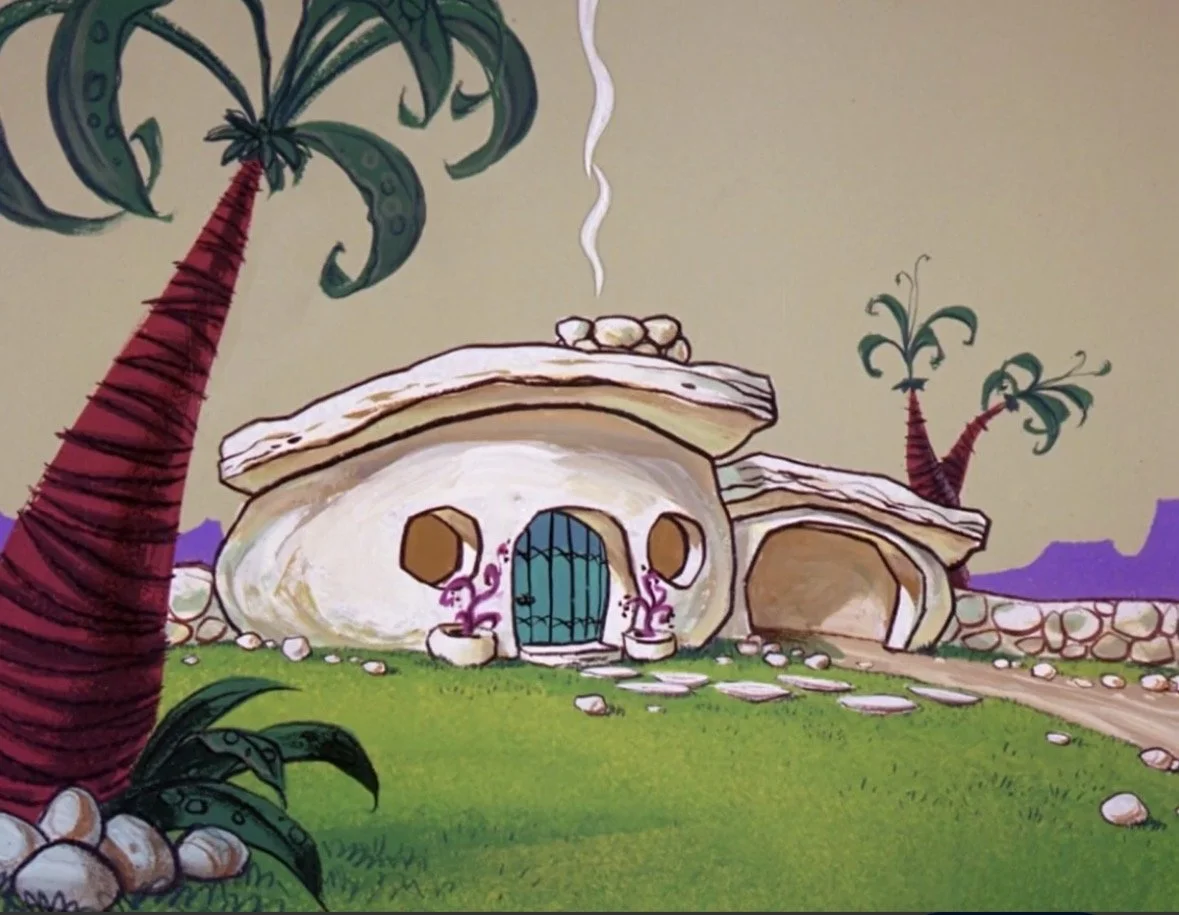
Bedrock was supposedly prehistoric, although it looked suspiciously like Southern California had been buried under several million years of sediment and then asked to wear a loincloth.
There were flat-roofed houses. Open spaces. Palm trees. Mountains. Big chunks of rock. Organic forms mixed with unmistakably midcentury ideas about how a family ought to live.
Architectural writers have also noted the visual relationship between Bedrock and Palm Springs, describing the show's setting as a mixture of Palm Springs modernism and the monumental rock formations of the Southwest.
And standing in the neighborhoods that are next to the San Jacinto Mountains, amidst the boulders, it is hard not to notice the similarity to Bedrock.
Whether Barbera and his artists literally looked at the San Jacintos and said, “Put this boulder here and that one there,” is harder to document.
But sometimes the desert does not need to be credited in the footnotes. It simply gets into your head.
His Legacy
The remarkable thing is how much of his work is still with us.
A young person today may have no particular reason to know who Joseph Barbera was. But mention Scooby-Doo, the Flintstones' car, George Jetson or Yogi Bear and the characters are still immediately recognizable. Yabba Dabba Doo.
They have outlived the medium that created them.
And somewhere in the middle of all this, Joseph Barbera was in Palm Springs.
A man who spent his professional life imagining the Stone Age and the year 2062 apparently looked at Palm Springs and decided that the present was strange enough.
Perhaps that was the appeal.
He had already discovered that reality is more entertaining when you don't insist on behaving as though it is normal.
Barbera was interviewed by Morley Safer on 60 Minutes in 1985. At the time he was still working at the studio with employees young enough to be his grandchildren. When Safer asked him if he had plans to retire, Barbera responded “I’m not gonna quit. There’s too many laughs to be had.”
He was still working in animation when he passed away at the age of 95 in 2006. He was a creative force in the industry for over seven decades.
Enjoyed this article? Explore more of our "Local…" series to discover the Palm Springs stories that helped shape the desert's singular character. You'll find collections devoted to food, architecture, celebrities, history, culture and the people who continue to make Palm Springs unlike anywhere else.
Join us at Artisan Food Tours on a walking food tour and taste the Palm Springs that lives between the postcards. You'll leave with a full stomach, a better map of the city's appetites, and quite possibly an appreciation for why this desert keeps inspiring creativity in so many people.
Dave Ball is a local tour guide and co-owner of Artisan Food Tours with his wife, Phyllis. He spends an inordinate amount of time thinking about Palm Springs history, neighborhood architecture, and where to find a great meal. He grew up in Hanna Barbera’s golden era and has many fond memories of the cartoons.
© David W. Ball