
The Local Questions, Vol. 5 | Field Notes From Palm Springs
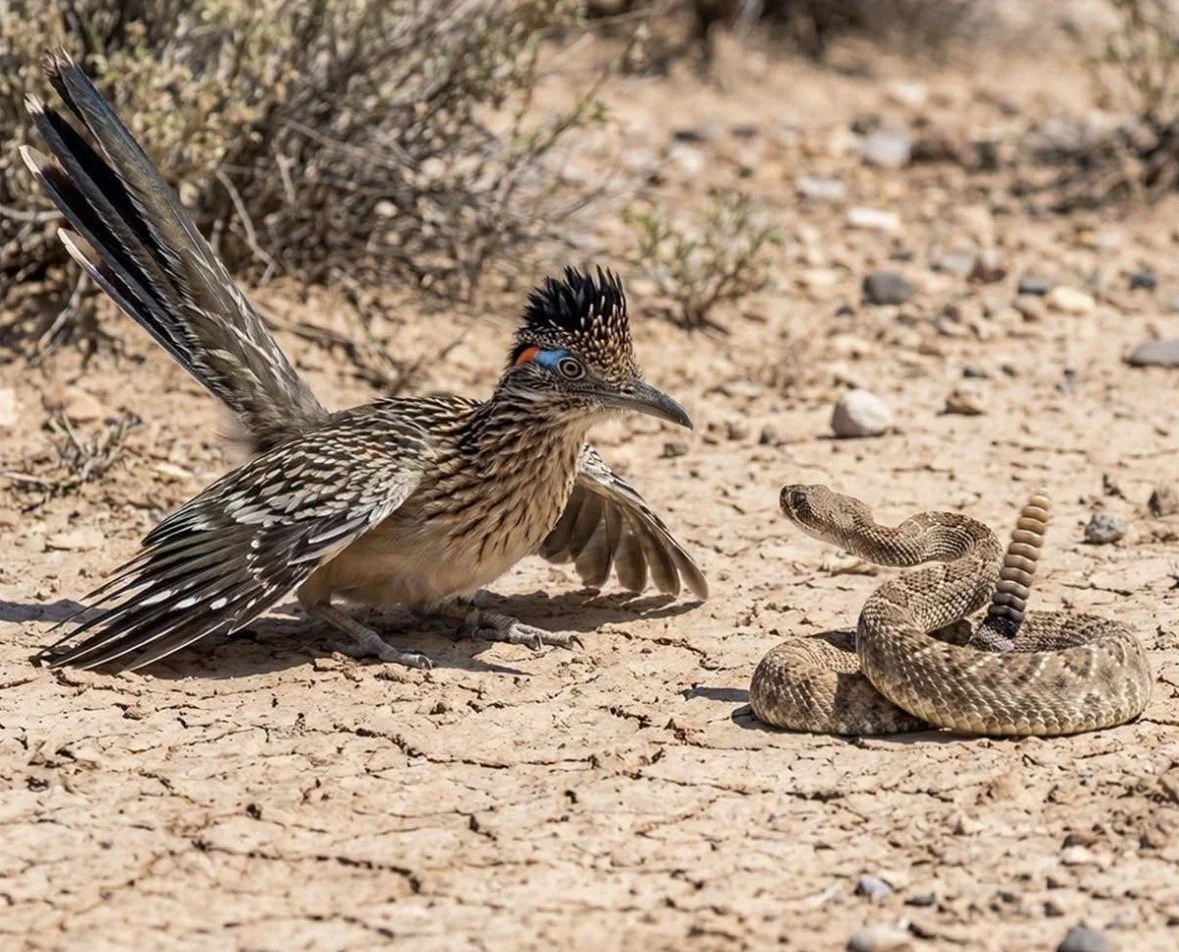
Live at the Thunderdome: Coyote vs. Roadrunner. Roadrunner vs. Rattlesnake.
We’ve already established in Field Notes, Vol. 4 that coyotes occasionally hunt roadrunners.
Which means that, somewhere out there in the Coachella Valley, the real-life version of the Wile E. Coyote and Roadrunner cartoons is playing out quite differently from the one we grew up with.
But you may not know that roadrunners in turn hunt rattlesnakes.
It's the desert's rough and tumble version of office politics.
Tonight’s Double Bill:
The Undercard:
Coyote vs. Roadrunner
The Main Event:
Roadrunner vs. Rattlesnake
The first matchup is pretty straightforward. Despite decades of animated humiliation, the real Wile E. Coyote is considerably faster than the real Roadrunner.
Coyotes can reach speeds of more than 40 miles per hour, while a roadrunner tops out at roughly half that.
In other words, if the cartoon had been even remotely realistic, the Roadrunner would have had a much shorter career. Maybe he had a good agent.
But the Main Event is where things really get interesting.
Because the Roadrunner isn't just capable of eating a rattlesnake.
It has a strategy for killing one.
A roadrunner hunting a rattlesnake doesn't simply stroll up and start pecking.
Instead, the bird uses speed and agility to stay out of striking range, sometimes working with another roadrunner. One bird distracts the snake by jumping, flapping and generally making itself impossible to ignore while the other approaches from the side and goes for the head.
And this is where the story takes a turn toward professional wrestling.
Once the roadrunner gets hold of the snake, it can slam it against the ground or a rock repeatedly, disabling it before swallowing it whole.
No knife. No fork. No tiny desert napkin.
Just a bird and a rattlesnake, settling things the old-fashioned way.
The roadrunner also has an impressive appetite for dangerous prey. It regularly eats venomous creatures, including rattlesnakes, scorpions and venomous lizards, without apparent ill effect.
There is a certain desert logic to all of this.
The rattlesnake is an ambush predator. It waits quietly, senses prey through heat-sensitive pits and chemical cues, strikes extraordinarily quickly and uses venom to subdue what it catches.
The roadrunner has essentially decided that none of this is a reason to be intimidated.
It is faster on its feet. It can keep moving outside the snake's striking range. And rather than trying to overpower the snake in a conventional sense, it uses the snake's own length and weight against it.
Then it eats the evidence.
So the next time a roadrunner darts across Palm Canyon Drive, don't think of it as the goofy bird from the cartoons.
Think of it as a small, feathered predator who figured out how to make rattlesnake part of the menu.
And keep in mind that there is probably a coyote somewhere watching the whole thing, waiting for dinner.
The desert doesn't reserve this sort of adaptability for wildlife.
People who live here learn the same lessons. Be quick. Stay adaptable. Know when to move—and when to hunker down.
Which raises a somewhat more complicated question: what's it actually like to live here?
We learn to adapt.
Or leave.
Life here is less of a permanent vacation than outsiders imagine.
And considerably more interesting.
Living here reveals the layers of history, the confluence of cultures, the sheer audacity of the pioneers and visionaries who created this place. I don’t take any of this for granted.
At the same time, underneath my continuing sense of wonder, there is the realization that daily life occurs here, like it does in any city.
People go to work.
Kids go to school.
Jensen’s on East Palm Canyon runs out of avocados just before dinner.
Trio, a longstanding local favorite, a restaurant in business for seventeen years, closes without warning.
It’s a tough way to go, this seasonal economy.
The seasons create a rhythm that's difficult to explain until you've experienced it.
Morning coffee outside in January.
Saying goodbye to friends in April, knowing, or at least hoping, that you’ll welcome them back in November.
This community has reinvented itself more than once without entirely forgetting who it was before. And it will again. And again after that.
The desert has a curious effect on people.
Some arrive for a weekend and leave.
Some arrive for the winter and stay.
Others come intending to escape something and discover they've simply found somewhere that feels unexpectedly like home.
We do have four seasons, like elsewhere.
But they’ve ratcheted up the thermostat about 30 degrees.
In fact, you could call our seasons:
Spring
Summer
Extra Crispy Summer
What the Hell Were You Thinking?
Like I said, you have to adjust. We do have a “hunker down” season, like up north. It’s just on the opposite side of the year.
More Desert Questions Coming Soon
The desert is generous with questions.
Why are the mountains different colors?
What’s with the brightly colored doors?
Why do people become oddly passionate about date shakes?
We'll keep asking.
Because around here, curiosity is part of the landscape.
Palm Springs makes more sense when you walk it slowly.
Join us at Artisan Food Tours on a guided food tour and see what the desert tastes like between questions. We promise that roadrunners and rattlesnakes won’t be on the menu. The roadrunner reportedly tastes terrible. The rattlesnake is off the menu on general principles, even though it tastes like chicken.
Enjoyed this article? The Local Questions are just one part of Devour the Desert. Explore our other "Local…" series for stories about the food, architecture, history, celebrities, and culture that make Palm Springs unlike anywhere else.
Come hungry. Leave like a local.
Dave Ball is a local guide and co-owner of Artisan Food Tours with his wife, Phyllis. He spends an inordinate amount of time thinking about Palm Springs history, neighborhood architecture, and where to find a great meal.