
The Local Questions, Vol. 9 | Field Notes From Palm Springs: Guest Complaints
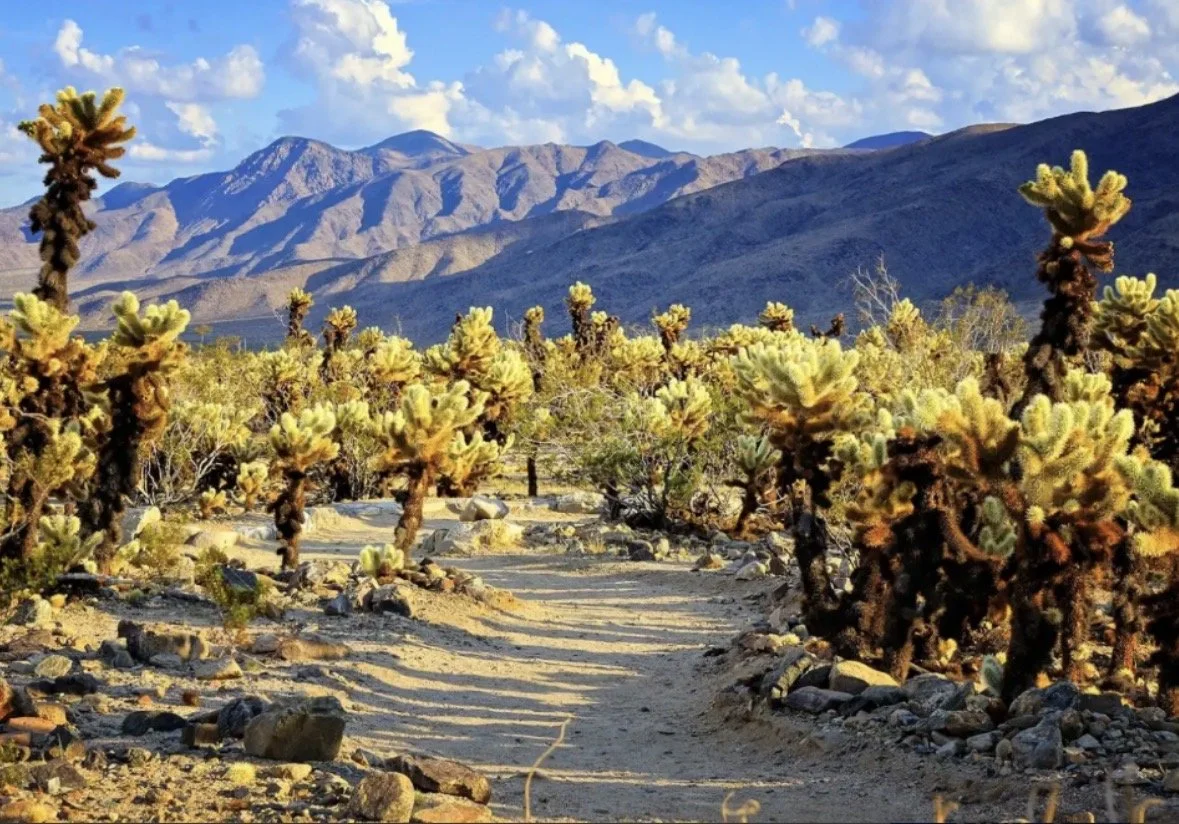
Cholla Cactus Garden, Joshua Tree National Park
Welcome to our occasional Guest Complaints issue.
We love our guests.
Really.
But after enough time in Palm Springs, you begin to notice that visitors have questions.
Some are philosophical.
Some are practical.
And some are essentially formal complaints filed against the desert.
Why are the stop lights so long?
Why does everything here want to prick me, bite me, or kill me?
Fair questions.
We will address them in the order received.
So… why are the stop lights so long?
Because Palm Springs has decided that patience is a desert survival skill.
This can be difficult to explain to someone who has spent the afternoon walking around in 108-degree heat and is now sitting at a red light watching absolutely nothing happen.
The light stays red.
And stays red.
And then, just when you have begun to suspect the city has forgotten you exist, it turns green.
There are respectable engineering reasons involving traffic flow.
So I’m told.
There’s a simpler explanation, though.
Palm Springs is not in a hurry.
It can afford not to be.
This is a city built around leisure. People come here to escape schedules, winters, bosses and, presumably, the concept of urgency itself.
You may have noticed that this philosophy extends to brunch.
And cocktails.
And the person walking three miles an hour directly in front of you while carrying a shopping bag the size of a small sailboat.
The traffic light is simply participating.
Don’t take it personally.
Besides, a long red light gives you time...
To contemplate the landscape… the mountains… the palm trees…
To reflect on the questionable decision you made to visit in August…
To experience an existential crisis about the meaning of life.
A fellow tour guide tells me he uses the time to take a nap.
You do you, babe.
Then the light turns green.
And everyone accelerates simultaneously as if they have just been released from prison.
So… does everything in the desert want to prick me, bite me or kill me?
No.
Some things merely want to make you extremely uncomfortable.
The desert has a reputation for hostility, and, to be fair, it has earned some of it.
There are thorns. Rattlesnakes. Scorpions.
Oh my.
There are plants whose entire evolutionary strategy appears to be please don't touch me.
But most of the desert isn't actually trying to kill you.
It is trying to avoid being eaten.
Admittedly, small comfort.
There's a cactus called teddy bear cholla because, from a distance, it looks soft and cuddly and exactly like something you'd want to hug.
Don't.
Here’s the clue: its other nickname is jumping cholla.
It doesn't actually jump. It just feels that way when tiny, resentful pieces detach the second you get close—like a plant that's been waiting all day for an excuse.
Appearances to the contrary, cacti can't jump or run away. Neither can ocotillo. So over millions of years, they developed other strategies.
Spines. Tough skins. Bad tastes.
The occasional chemical warning.
Do we all know people like this?
Or is it just my circle of friends?
The desert is not being aggressive.
It is playing defense. And being economical.
Water is scarce. Shade is scarcer. Food is scarcerer.
Everything here has learned to make the most of what it has.
Some things grow armor. Some things grow venom. Some things grow very fast legs.
The local wildlife all have their own version of the arrangement.
Rattlesnakes would generally prefer not to encounter you. They are not lying behind a rock all day waiting for their chance. They have other things to do.
Scorpions are similarly unlikely to have you on their calendar.
And the desert bighorn sheep are mostly interested in finding food, water and a suitably dramatic cliff from which to survey their kingdom.
The important thing is to respect the terms of the arrangement.
Don't put your hands somewhere you can't see.
Don't pick up wildlife.
Don't pet things because they look cute.
And if something in the desert appears to be covered in spines, assume that this is not an invitation.
The desert isn't trying to hurt you. At least most of the time.
The rules get a little different during summer, when the sun appears to have taken personal offense at the very existence of life.
The desert has simply discovered that the easiest way to survive is to make itself difficult to touch.
Which, come to think of it, has become a fairly good description of Palm Springs real estate.
A brief note from the field
If you have another question about Palm Springs that has begun to seem increasingly strange the longer you stay here, send it our way.
We've been here long enough to know that the questions can get… interesting.
And occasionally… concerning.
Want to experience the desert without having to figure it all out yourself?
That's rather the point of our tours.
On an Artisan Food Tours walking tour, we'll introduce you to Palm Springs one memorable bite—and a few good stories—at a time. You'll meet people shaping the city's food scene, hear the history behind the streets you're walking, and discover the architecture, characters and concerning little details that are easy to miss when you're exploring on your own.
Come curious. We'll take it from there.
Dave Ball is a local guide and co-owner of Artisan Food Tours with his wife, Phyllis. He spends an inordinate amount of time thinking about Palm Springs history, neighborhood architecture, where to find a great meal—and occasionally wondering why the traffic light is still red.