
The Date Shake: Theory and Practice
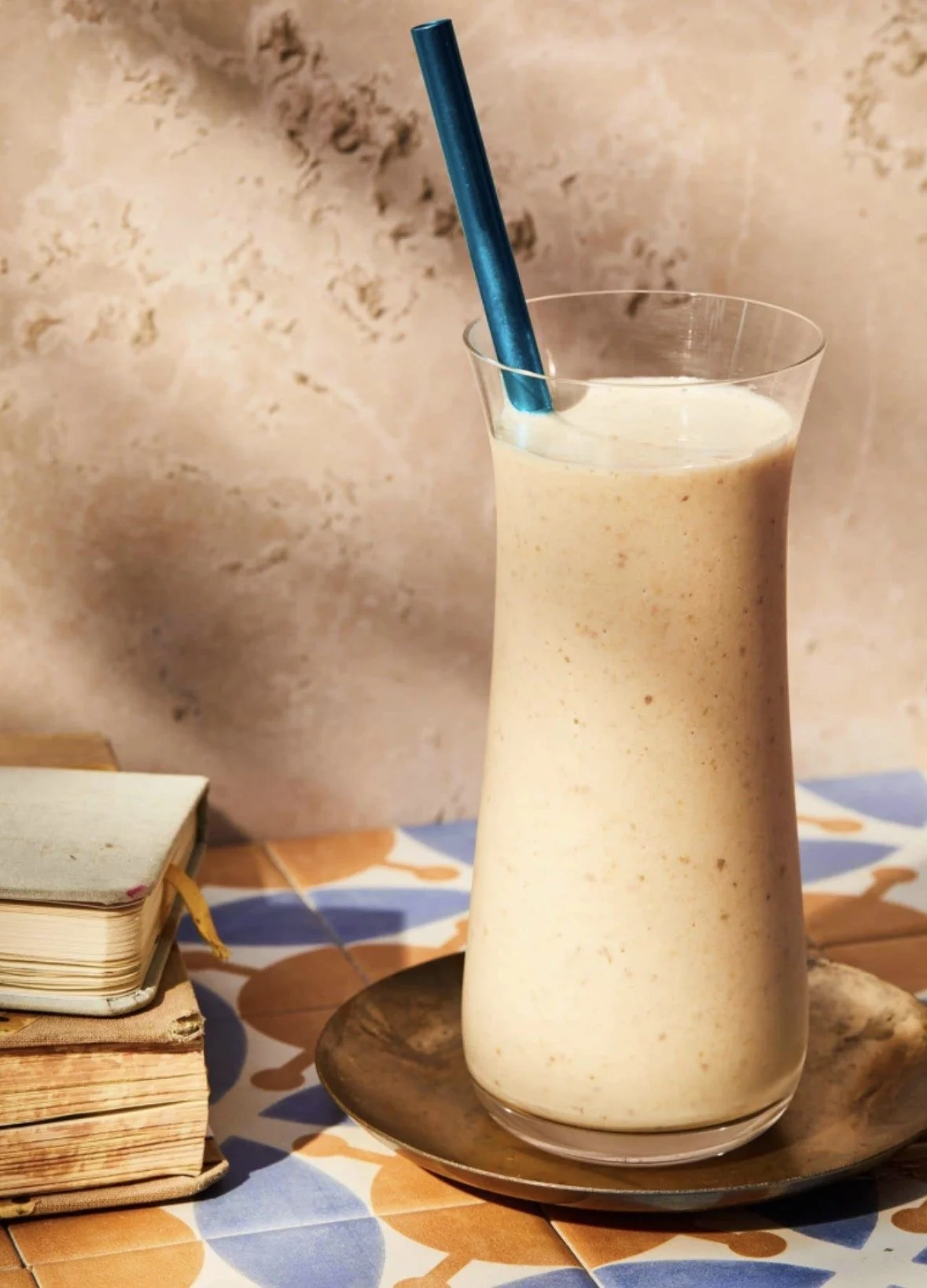
The classic date shake
There is a particular kind of American confidence required to look at the hottest, driest, least forgiving stretch of ground in California and think: palm trees.
Not the palm trees that already grow wild in a handful of shaded canyons nearby, mind you, where springs seep up through granite and the Cahuilla people had the good sense to settle centuries before anyone else showed up with other opinions.
No. Imported palms.
Palms from Iraq, Algeria and Egypt. Palms that had spent their entire evolutionary history perfecting themselves along the banks of the Euphrates, now expected to make a go of it in a valley where summer temperatures can reach 120 degrees and the annual rainfall might not fill a shot glass twice.
The pitch was essentially: if it grows there, maybe it'll grow here.
Around 1900, agricultural explorers from the United States Department of Agriculture—a job title that sounds invented but was not—went looking for crops that might thrive where nothing sensible would grow. They came back with date palm cuttings from North Africa and the Middle East, on the theory that if a plant could survive there, it could probably survive here, too.
It worked.
This is the part of the story that never stops sounding slightly absurd to me: it actually worked.
The Coachella Valley now produces more than 90 percent of the dates grown in the United States, which means that one of the world's oldest cultivated fruits, loaded with thousands of years of biblical and literary baggage, is now likely to have been grown less than an hour away.
The gap between where a thing comes from and where it ends up is part of what makes this valley interesting.
And the date shake, a local food star if there ever was one, is a good place to go looking for it.
The Man Who Didn't Invent It
Ask around Indio who invented the date shake and you will, with some reliability, be told: Floyd Shields.
This is understandable. Shields spent much of the twentieth century making the date shake synonymous with his name.
But the more careful accounts point elsewhere—to a man named Russ Nicoll, who operated a roadside stand called the Valerie Jean Date Shop a few miles south, near Thermal, sometime in 1928.
The story goes that Nicoll had read that certain communities in the Middle East lived largely on dates and goat's milk and thought: why not try that in a blender?
It is, as origin stories go, refreshingly free of legend.
No visions. No divine intervention. No mysterious stranger appearing at the door with a sacred recipe.
Just a man with dates, milk and the kind of idle curiosity that can produce something useful.
Floyd Shields had already been farming dates since 1924, when he and his wife, Bess, traded a Long Beach apartment for a run-down palm grove and moved to a town of about five hundred people to try their luck.
What Shields contributed to the date shake, strictly speaking, wasn't the shake.
It was the infrastructure.
In 1936, Shields developed date crystals: small, dried particles of date that could be reconstituted into a paste. Suddenly, a date shake no longer required somebody to stand behind a counter chopping fresh dates by hand while a line of increasingly impatient motorists waited in the desert heat.
It is not a particularly romantic innovation. It is closer to what a food chemist does than what an artist does.
But it is the reason the date shake became something you could reliably order at a roadside stand instead of something you occasionally got lucky with.
And there is a version of the American food story—the diner, the drive-in, the milkshake, the franchise—that runs almost entirely on this kind of unglamorous industrialization of a good idea someone else had first.
Shields may not have invented the shake, but he did something very important: he turned it into an institution, building an entire theater, mythology and gift shop around Nicoll's genuine spark. He also developed date hybrids and other agricultural innovations.
The Shields name is still in business more than a century after Floyd first traded his apartment for a run-down grove.
All of this is its own kind of genius.
The Sex Life of the Date
Which brings us, inevitably, to the film.
In 1951, Floyd Shields opened an air-conditioned theater on Highway 111 and began screening a fifteen-minute educational program titled The Romance and Sex Life of the Date.
It played on a loop.
It still does.
This makes it one of the longer-running tourist presentations in America. Longer than most marriages. Certainly longer than most people's patience for educational programming about agriculture.
The film is not, whatever the marquee implies, especially racy. It concerns pollination.
Date palms are dioecious, which means male and female flowers grow on separate trees. Something therefore has to get the pollen from one to the other—a task that, for much of the crop's history in the valley, was done by hand, by a worker up a ladder with a small brush.
I guess the bees were busy elsewhere.
This was, in essence, heterosexual matchmaking for trees.
I suspect the courtship was brief.
Shields understood, correctly, that a lecture on this process would empty a room in about four minutes.
A lecture with the word sex in the title, however, might not.
“Oh, that shocked people then!” Bess Shields said decades later, sounding less apologetic than pleased.
She was right to be pleased.
It is a small, perfect piece of American marketing: take the driest possible subject, put a provocative word on it and let curiosity do the rest.
I should have called this article “Date Shake Booty Call.”
The tourists came expecting scandal and left knowing more about pollen than they had ever intended to. Everyone got what they wanted, more or less. Which may be the only honest definition of a good tourist attraction.
Theory
So.
What makes a good date shake?
There are, broadly, two schools.
The Shields school uses date crystals—the paste-reconstituted-from-dried-particles method Floyd developed in 1936—blended with vanilla ice cream. While Shields did successfully create two custom, proprietary hybrids back in 1927, cheerfully naming them Blonde and Brunette (which sounds less like horticulture than a 1940s horse racing form), the crystals are a separate breakthrough.
Rather than using the two hybrids, the crystals are made from completely dehydrated and ground choice dates, typically the abundant Deglet Noor variety. The resulting dry flakes are shelf-stable to bypass desert heat and sufficiently sweet to become the backbone of the whole enterprise.
In 2022, there was even a bill to make the date shake California's official state milkshake. It passed the Assembly, then died quietly in the Senate.
At least locally, Shields did get the recognition. That same year, Indio and Riverside County recognized the Shields date shake as the official county date shake.
I did not know there was an official county shake. I now know there is an official county shake, and I am glad I do. I am not entirely sure how I got along before this information entered my life.
But while Shields built an empire on dehydrated convenience, his rivals were quietly digging their heels in the sand. Their old school approach still uses fresh dates, blended whole or baked first into a paste, with milk and ice cream added after.
Purists on this side of the argument will tell you the crystal version is a shortcut. They are correct. But does that mean their version is better?
Try both and decide for yourself. Then you can debate which is better, like Chicagoans arguing about thin crust versus deep dish or Southerners arguing about barbecue.
People get religious about those things. Around here, we're considerably more relaxed. Have a little fun and chill out, dude.
And, this is my personal opinion: whichever team you sign up with, keep it simple and straightforward. No chocolate syrup, no whipped cream. No maraschino cherry. It all takes away from the complex date flavors.
This is my conviction, and here I stand.
A man's got to believe in something.
What both schools do agree on, whether they say so or not, is texture.
A date shake that separates into gritty flecks and thin milk has failed at the one job it has.
A good one should have the thick, faintly grainy pull of a shake that is being genuinely stubborn about staying in the straw, but that ultimately relents, so as not to require the lungs and abdominals of a pearl diver just to enjoy a sip.
It should be sweet in a way that tastes like caramel, while quietly remembering it used to be a fruit, with just enough of the date's characteristic mineral depth to keep it from becoming nothing more than simple sugar.
It should, in other words, taste like something that grew in impossible conditions and is not going to let you forget it.
Practice
A Basic Date Shake, Home Version
1 cup vanilla ice cream
1/2 cup whole milk
4–5 pitted Medjool dates, softened in warm water for ten minutes if firm
A small pinch of salt
Blend until the dates disappear entirely into the mixture.
This takes longer than you expect.
An under-blended date shake is a worse failure than an over-thick one.
Taste before serving.
A truly good date needs almost nothing added to it, which is either the whole point of the exercise or a small rebuke to everyone who has ever put a date shake through the aforementioned chocolate syrup/whipped cream/maraschino cherry treatment.
Where to Get One Today
Shields Date Garden remains the pilgrimage site. Crystals, film, roadside knight sign and all.
You can watch the pollination lecture that “shocked” people in 1951 while you wait for your shake, and I recommend you do, because knowing the plot twist makes the marquee funnier rather than less effective.
A handful of other stands in the East Valley near Shields make their own versions, some leaning toward the fresh-date school. There are also several choices along Palm Canyon Drive in Palm Springs, Great Shakes and Lappert’s being two examples, both downtown.
Great Shakes likes to put a donut and whipped cream on top. Lappert’s likes to slather chocolate syrup on the inside of the cup. You already know my opinion on such matters.
The Windmill Market is about seven miles north of town on N. Indian Canyon, past the I-10 intersection but worth the drive into the desert.
Comparing them is a genuinely pleasant way to lose an afternoon while gaining a thousand calories, give or take.
But you must pace yourself.
This is not a beverage built for restraint.
There is a lot of history in that cup.
A fruit that shouldn't grow here, grown here anyway.
A shake invented by one man, perfected and marketed by another.
A theater built to explain tree sex to tourists who came for the innuendo and stayed for the horticulture.
This is not high culture. It is fun. A vintage roadside sign depicting an armored knight with a shield, a film that's been running since Truman was president, a shop selling tourist curio items that look like something from the 1950s.
And one delicious milkshake.
You may think you don't like dates.
Order the shake anyway.
And, if you close your eyes and taste, it all turns into a microcosm of the entire Coachella Valley.
Unlikely agriculture, showmanship and staying power.
All blended together and served cold.
The date shake is only one of the strange and delicious stories hiding in the desert. If you’d like to discover a few more of them, join us on an Artisan Food Tours walking tour of Palm Springs. We’ll explore the food, architecture, history, celebrities, and culture that make this valley such a fascinating place.
Come hungry. We’ll take care of the rest.
Dave Ball is a local guide and co-owner of Artisan Food Tours with his wife, Phyllis. He spends an inordinate amount of time thinking about Palm Springs history, neighborhood architecture, and where to find a great meal. He does like a good date shake. But he’s not taking sides in the Great Date Shake War.
copyright: david w. ball