
The Local Questions Vol. 3 | Field Notes from Palm Springs
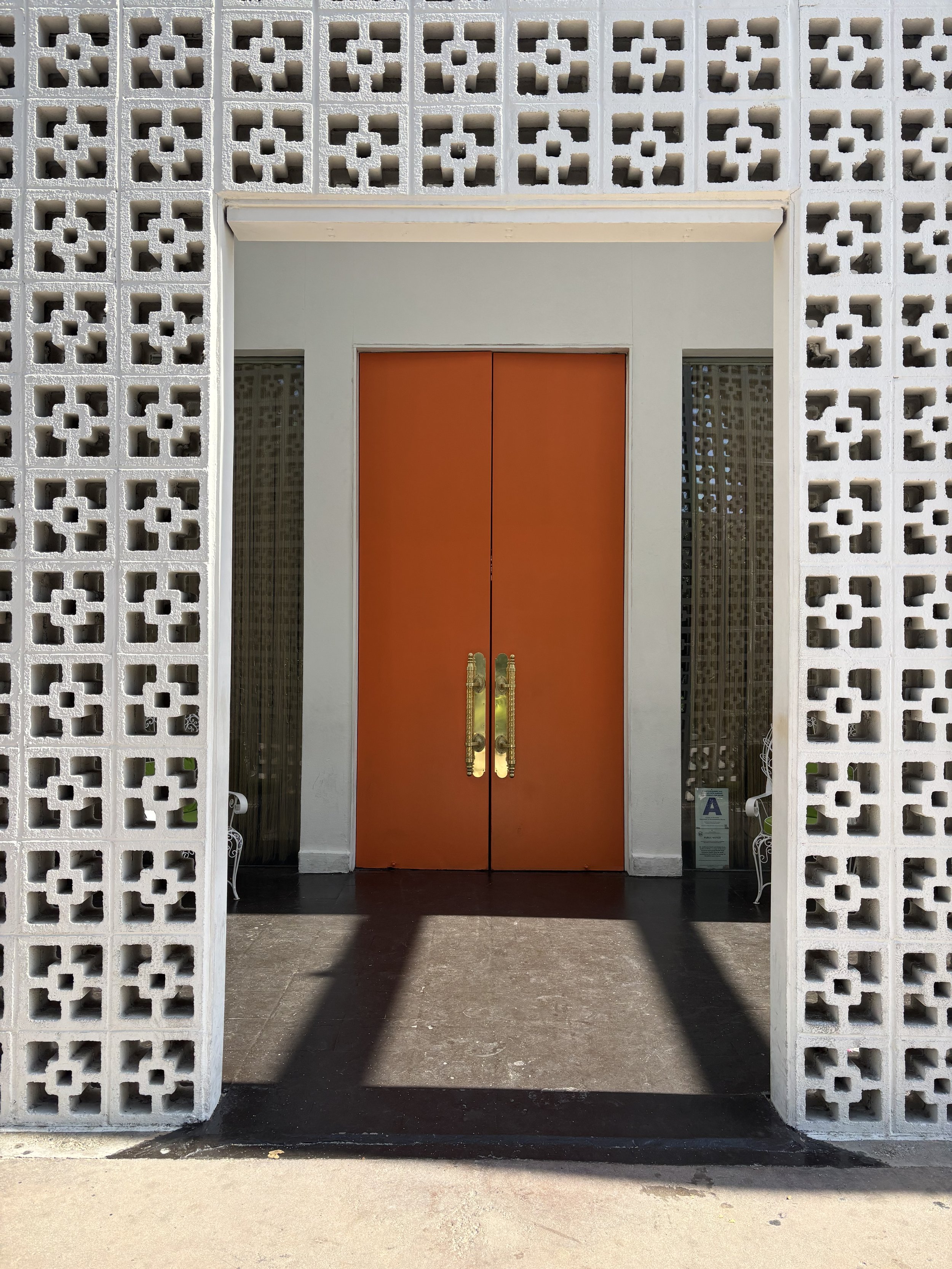
Parker Palm Springs Hotel
After enough tours, you realize Palm Springs visitors don't just ask where to eat.
They ask the questions that seem simple—right up until you try answering them.
So what's up with all the orange?
Why are there hummingbirds everywhere?
Should I be worried about the tram?
Every place develops its own frequently asked questions. These happen to be ours.
Here are four.
So... What's Up with All the Orange?
If you spend a day in Palm Springs, you'll begin to notice a recurring color.
Orange umbrellas.
Orange patio cushions.
Orange front doors.
Orange signs.
Orange cocktails.
Orange clothing.
At some point you'll begin to wonder whether the city receives municipal funding from citrus growers.
It doesn't.
Orange simply works here.
Against the blue desert sky and the muted tans of the surrounding mountains, orange practically vibrates. Mid-century modern designers understood this. The architecture often favors restrained palettes—white walls, natural stone, desert landscaping—which allows bold accent colors to do the heavy lifting.
Orange also happens to echo the desert itself. Not this minute, necessarily, but the desert at sunrise, sunset, and those other magical moments when the San Jacinto Mountains seem to glow from within.
It's cheerful without being loud. Retro without feeling trapped in the past.
Frank Sinatra embraced orange, too. The color appeared everywhere, from his wardrobe to his home décor. He seemed to understand what designers already knew: against a desert backdrop, orange simply sings.
And yes, after a few days, you may find yourself quietly considering an orange front door back home.
We suggest you talk to the neighbors first. And bring cookies.
What looks wonderful here can be a bit loud in a more conventional location.
Why Do Hummingbirds Hum?
Short answer: because they don’t know the words.
Slightly longer answer: It’s the beating of their wings.
And for all of us science geeks, let’s dive in:
Hummingbirds are named after the distinctive humming sound created by the rapid movement of their wings. When these tiny birds fly or hover to feed, their wings beat anywhere from 12 to 80 times per second. This extreme speed creates vibrations and air pressure differences that we hear as a gentle hum.
The hum announces their presence. Finding the hummingbird making it, however, is another matter.
There's real science behind the hum. Unlike most birds, which generate most of their lift on the downstroke, hummingbirds generate lift on both the upstroke and the downstroke. Their wings move in a figure-8 pattern. This unique wing movement gives them the energy and agility to hover in mid-air and fly backward.
Because they rely on hovering flight—one of the most metabolically expensive forms of movement—their bodies operate at an intensity that leaves very little room for an empty fuel tank. Their hearts can beat more than 1,000 times per minute.
In short, they’re one of the hardest working creatures on our planet. Those itsy bitsy flying gems are metabolizing resources like little blast furnaces. To survive, they must eat roughly half to twice their body weight in nectar and insects every single day.
If humans had their metabolism, they would need to eat around 300 pounds of hamburgers a day.
Because they burn energy so quickly, they are only a few hours away from starvation at any given moment. To survive the night without eating, they enter a remarkable metabolic state called torpor, dropping their heart rate to as little as 40 beats per minute to conserve energy.
Our flowering plants provide something hummingbirds appreciate tremendously: reliable food in a place where reliability is otherwise in short supply. It’s a daily buffet in Palm Springs, open breakfast, lunch and dinner.
So these delightful little creatures spend their days doing what most tourists do:
Flitting from one attractive destination to another while stopping frequently for snacks and refreshments.
How Do the Locals Handle the Summer?
The short answer?
We adapt.
Palm Springs summers are not simply hot. They're strategic.
Locals learn quickly that errands happen early. Dog walks happen earlier. Golf often begins at sunrise. Dinner reservations migrate later into the evening. Swimming pools become less of a luxury and more of an operating system.
Air conditioning achieves near-religious status.
Many residents also leave for part of the season. Others stay and quietly enjoy one of our best-kept secrets.
Everything slows down. Restaurant reservations become easier. Parking becomes effortless.
You can drive across town without wondering whether everyone else received the same memo. The pace becomes almost... civilized.
Besides, every local knows October arrives eventually (and yes, September is definitely still summer here).
Will Riding the Palm Springs Aerial Tramway Be Scary? And Is It Worth It Anyway?
For some people, yes.
For almost everyone, also yes.
The Palm Springs Aerial Tramway climbs more than 5,800 feet in about ten minutes while the rotating floor provides steadily expanding views of the valley below.
If you're uncomfortable with heights, you may spend part of the ride negotiating with your own nervous system.
As for stability, the good news is that there is a handrail to steady yourself.
The bad news is that it rotates with the tram. You might want to practice your hand-over-hand repositioning maneuvers before boarding.
As for safety, the good news is that the tram is exceptionally well maintained, professionally operated, and has safely carried millions of passengers over the decades.
The bad news is that it’s now old enough to qualify for Social Security. But no age discrimination from your field guide here; I'm in the same category.
The best news comes at the top.
Within minutes you've traded desert floor temperatures that may exceed 110 degrees for cool mountain air, towering pines, hiking trails, and views across the entire valley.
It's one of the few places where you can experience two dramatically different climates before lunch.
Just remember to bring a light jacket, even on the hot days.
The desert has a mischievous sense of humor.
Join Us on the Tour
Questions like these come up constantly on our tours, usually somewhere between an unforgettable taste and a fascinating local story.
If you'd like to discover more of Palm Springs, one memorable bite at a time, join us on an Artisan Food Tours walking food tour. Along the way we'll introduce you to remarkable restaurants, hidden architectural details, local history, and the answers to the questions visitors are always curious enough to ask.
Want more answers to the questions you didn't know you had?
Keep exploring The Local Questions—field notes from a place that never seems to run out of mysteries. We'll be adding more. Chances are, yours will be on the list.
Come hungry. Leave like a local.
Enjoyed this article? The Local Questions are just one part of Devour the Desert. Explore our other "Local…" series for stories about the food, architecture, history, celebrities, and culture that make Palm Springs unlike anywhere else.
Dave Ball is a local guide and co-owner of Artisan Food Tours with his wife, Phyllis. He spends an inordinate amount of time thinking about Palm Springs history, neighborhood architecture, and where to find a great meal.