
The Local Landscape | The Fault Isn’t in the Stars. It’s Under our Feet
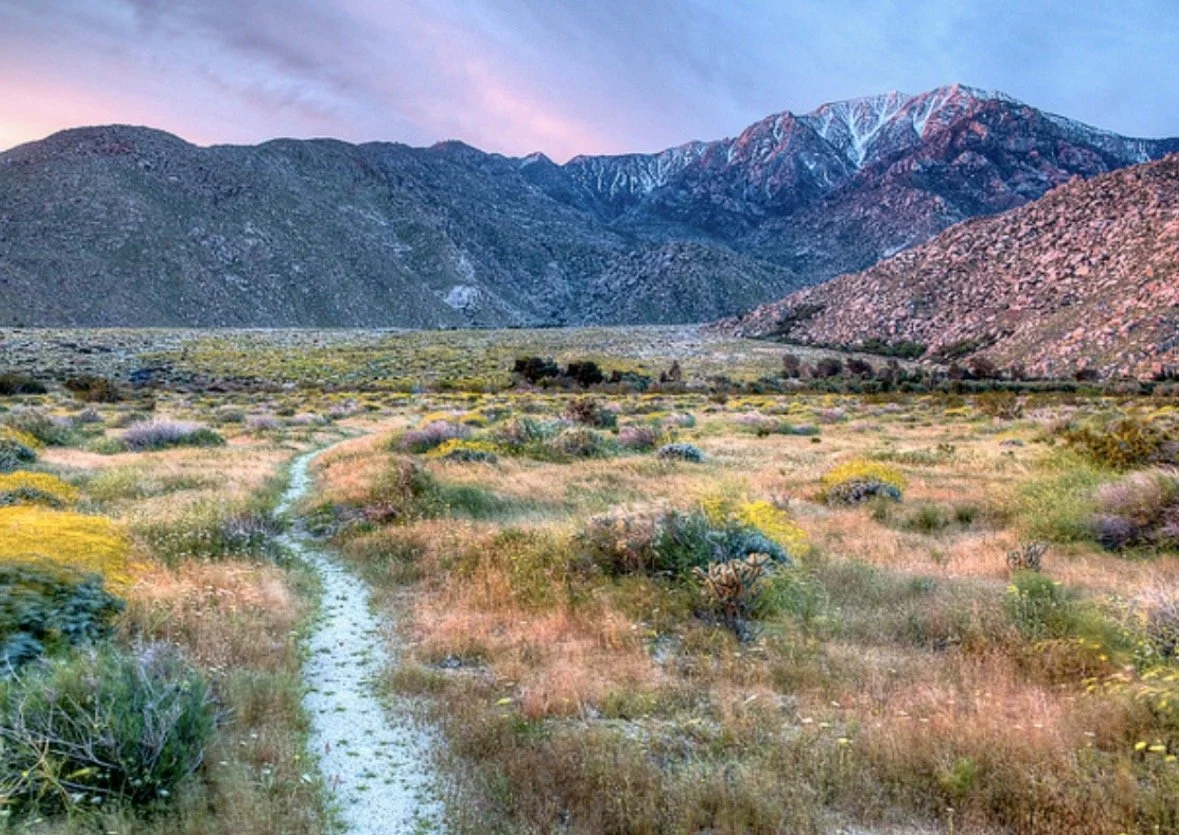
Coachella Valley looking south toward San Andreas Fault and Mount San Jacinto
How colliding continents created the Coachella Valley, our famous springs—and the earthquake we're all politely pretending isn't coming.
Some cities were built beside rivers.
Some grew around natural harbors.
Palm Springs exists because the Earth never learned to sit still.
Long before movie stars, modernist architects, date shakes or impossibly expensive cocktails, enormous slabs of the Earth's crust spent millions of years grinding past one another. They lifted mountains, dropped valleys, cracked open the desert floor and allowed underground water to rise to the surface.
In other words, our entire valley is the result of one extraordinarily successful geological disagreement.
Fortunately for us, geology has excellent taste.
The Valley That Fell Between the Mountains
Stand anywhere in Palm Springs and look west.
Those dramatic San Jacinto Mountains don't simply rise from the valley floor.
They explode upward.
Within just a few miles, the landscape climbs from roughly 500 feet above sea level to more than 10,800 feet at San Jacinto Peak—one of the steepest elevation gains anywhere in North America.
That isn't erosion.
It's tectonics.
The San Jacinto Mountains are what's known as a fault-block mountain range. Massive sections of Earth's crust were pushed upward along fractures while neighboring blocks sank, creating the broad Coachella Valley below.
Nature didn't carve these mountains.
It lifted them.
Rather aggressively.
Look West. That's Not Normal.
There's a reason first-time visitors stop in the middle of Palm Canyon Drive and instinctively look west.
The mountains seem impossibly close.
That's because they are.
The western edge of Palm Springs is defined by one of the most dramatic fault escarpments in North America. The San Jacinto Mountains don't gradually roll upward the way the Rockies or Appalachians often do. They erupt almost straight out of the valley floor, climbing more than two vertical miles in just a handful of horizontal miles.
It's as though someone grabbed California by one edge and gave it a sharp upward tug.
Every restaurant patio with a mountain view owes its scenery to millions of years of relentless tectonic uplift. The happy hour may be two-for-one. The backdrop took considerably longer to prepare.
And it’s still in process today. The mountains are still rising. The fault is still moving. The valley is still changing.
Meet Our Most Influential Neighbor: The San Andreas Fault
The celebrity residents may come and go.
The San Andreas Fault has been here for roughly 30 million years.
It marks the boundary between two enormous tectonic plates:
The Pacific Plate
The North American Plate
These plates aren't politely drifting apart.
They're sliding sideways past each other at about two inches every year.
That doesn't sound impressive until you remember they've been doing it for millions of years.
It's the geological equivalent of moving your couch one inch every week.
Eventually you'll discover it's somehow in another room.
Why We Have Mountains Instead of Beaches
As these plates grind together, pressure builds.
Sometimes the land slips.
Sometimes it rises.
Sometimes it drops.
Over millions of years, those movements created:
The San Jacinto Mountains to the west
The Santa Rosa Mountains to the southeast
The Little San Bernardino Mountains to the north
The broad Coachella Valley basin in between
Every spectacular desert view exists because the Earth's crust has been rearranging the furniture for millions of years.
The Springs That Named Palm Springs
Here's the beautiful part.
Faults don't just move rocks.
They move water.
Rain and snow falling high in the San Jacinto Mountains slowly seep underground. As that groundwater travels through layers of rock, fault lines act like underground dams and pipelines, forcing water back toward the surface.
For thousands of years, these springs made permanent life possible in a place that otherwise should have been inhospitable. Palm Springs wasn't discovered by Hollywood. It was first settled and sustained by people who understood that in the desert, water is destiny.
Without fault lines...
No springs.
Without springs...
No oasis.
It's difficult to overstate how much we owe an active fault.
Earthquakes: The Price of Living Somewhere Interesting
If tectonic plates moved smoothly, earthquakes wouldn't exist.
Unfortunately, rocks are stubborn.
Instead of sliding continuously, they lock together.
Pressure builds.
More pressure.
Even more pressure.
Then—sometimes after decades or centuries—they suddenly break free.
That's an earthquake.
The shaking lasts seconds.
The stress may have accumulated over hundreds of years.
Talk about procrastination.
Our Earthquake History
Southern California experiences thousands of earthquakes every year.
The overwhelming majority are so small nobody notices them.
The larger ones are reminders that our landscape remains a work in progress.
Some memorable events include:
1948 Desert Hot Springs earthquake
1986 North Palm Springs earthquake
1992 Landers earthquake, one of California's largest in modern history
2010 El Mayor-Cucapah earthquake, centered in Baja California but strongly felt throughout the Coachella Valley
Each released pressure.
None released all of it.
So... What About "The Big One?"
Yes.
Geologists generally agree the southern section of the San Andreas Fault is capable of producing a major earthquake—possibly in the magnitude 7.8 to 8 range.
The southern portion hasn't experienced a truly massive rupture for roughly 300 years.
In geological terms?
That's yesterday.
Nobody knows whether the next major event happens tomorrow...
Or 150 years from now.
Earthquakes don't work from Outlook calendars.
What scientists do know is that strain continues to accumulate as the Pacific Plate inches northwest every year.
Eventually, physics wins.
Should We Panic?
Not even slightly.
Should we prepare?
Absolutely.
A few simple steps go a long way:
Keep emergency water and food.
Secure heavy furniture.
Know how to shut off utilities if necessary.
Have flashlights, medications and supplies ready.
Keep comfortable walking shoes handy.
Life in earthquake country is a little like owning a fire extinguisher.
You hope it gathers dust forever.
You're glad it's there if it doesn't.
Why Geology Makes Palm Springs Better
Once you understand how this valley formed, everything looks different.
It's difficult to enjoy lunch on a restaurant patio without realizing the scenery was assembled over an astonishing amount of time.
The chef may deserve five stars.
The landscape deserves at least six.
You Can Stand on the San Andreas Fault
One of the surprising things about the San Andreas Fault is that it isn't hidden beneath skyscrapers or buried miles underground.
In parts of the Coachella Valley, you can actually stand on it.
Drive a few minutes northeast of Palm Springs toward Thousand Palms Preserve or Indio Hills and you'll find a landscape that suddenly feels... different. Long, straight valleys. Abrupt ridges. Strange offsets in the terrain. These aren't random desert features—they're scars left by millions of years of the Pacific Plate and North American Plate slowly sliding past one another.
Devour the Desert Takeaway
Palm Springs isn't beautiful despite its geology.
It's beautiful because of it.
Every meal enjoyed beneath the San Jacintos, every cocktail sipped at sunset and every stroll through downtown happens on a landscape that remains gloriously unfinished.
The Earth is still building Palm Springs.
Fortunately, it's taking its time.
Hungry After 30 Million Years?
Understanding Palm Springs isn't just about architecture or celebrity history—it's about the landscape that made everything else possible.
On an Artisan Food Tour, you'll hear the stories behind the neighborhoods, historic buildings, local restaurants and surprising history that all grew from this remarkable desert oasis. Along the way, you'll enjoy some of downtown's most memorable bites while discovering that every great meal comes with an even better story.
Because around here, even the geology pairs nicely with dinner.
Quick Geological Highlights
Formation: Approximately 10–30 million years of tectonic activity
Mountain Type: Fault-block mountains
Highest Peak: San Jacinto Peak (10,834 feet)
Plate Movement: About 2 inches per year
Primary Fault: Southern San Andreas Fault
Why Palm Springs Exists: Faults forced groundwater to the surface, creating life-giving springs
Earthquake Outlook: Large earthquakes are inevitable in geologic time—but impossible to predict precisely.
Enjoyed this article? Explore more of our "Local …" series to discover the Palm Springs stories that helped shape the desert's singular character. You'll find collections devoted to food, architecture, celebrities, history, culture and the people who continue to make Palm Springs unlike anywhere else.
Dave Ball is a local tour guide and co-owner of Artisan Food Tours with his wife, Phyllis. He spends an inordinate amount of time thinking about Palm Springs history, neighborhood architecture, and the pursuit of a great meal. His reigning food obsession remains local Deglet Noor dates with Fix & Fogg Crunchy Peanut Butter, but the breakfast bread at Bread & Flours Bakery in Palm Springs is mounting a serious challenge for the title. Stay tuned for this rapidly developing story.