
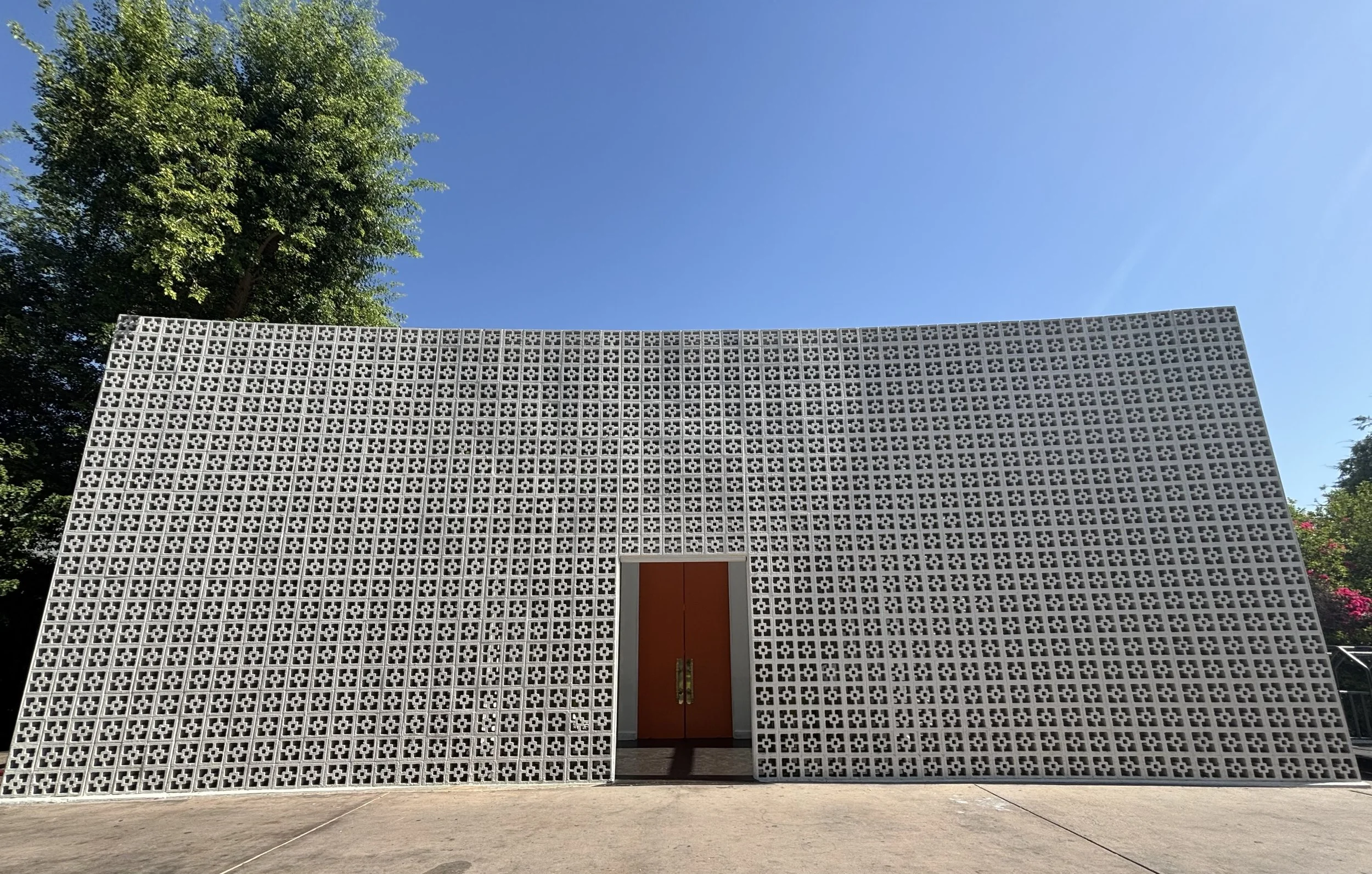
Vista Vue pattern breeze block wall at The Parker Palm Springs Hotel
There are certain things you see so often in Palm Springs that you stop seeing them.
Palm trees. Swimming pools. Flat roofs. Mountains that look as though someone forgot to finish painting the horizon.
And the breeze block.
You have almost certainly seen it. Those decorative concrete blocks with geometric openings, stacked into walls, carports, entryways and garden screens. Sometimes white. Sometimes the color of the house. Sometimes pink, turquoise, mustard or some other shade that would look alarming on a paint-store color chart.
In Palm Springs, however, perfectly reasonable.
Breeze block is one of the great unsung heroes of Mid-Century Modern architecture. Inexpensive, practical and adaptable. It provides shade, privacy and ventilation. And, with a little help from an architect who understood the value of a good pattern, it could turn an ordinary wall into sculpture.
Not bad for a chunk of concrete.
An old idea gets a modern makeover
The basic idea was hardly new.
For centuries, architects and builders in hot climates had used perforated screens, lattices and patterned masonry to filter sunlight while allowing air to move through. The concept appeared in various forms of Islamic, Indian and Asian architecture and in Brazil's cobogó, a perforated architectural block patented there in 1929.
The French called the idea brise-soleil, literally a "sun break"—a device designed to interrupt the sun before it reached the building. Breeze block was only one type of brise-soleil.
Postwar American architecture was interested in all of this.
Some American architects were also interested in creating designs that could be built at lower cost, thereby making modern design available to a broader range of clients. This populist idea had deep roots in the European modernist movement, including the Bauhaus, where designers were wrestling with industrial production and how modern design might serve the public.
In 1931, Albert Frey and A. Lawrence Kocher designed the Aluminaire House in New York as an experiment in precisely this kind of thinking. The little house was assembled from standard, off-the-shelf industrial materials and erected in just ten days. It was, in part, a house as architectural argument: modern design did not necessarily have to mean expensive custom craftsmanship. It could be sheets of aluminum held together with rivets. Industrial production could be part of the solution.
Albert Frey later became the first architect to make Palm Springs his home. The Aluminaire House is now, fittingly, on permanent display on the grounds of the Palm Springs Art Museum.
This all points to one of the fascinating tensions within Mid-Century Modernism.
On one side was high design: the architect as artist, creating a singular house for a singular client, with every detail designed for that particular place and person.
On the other side was the idea that good design could be standardized, repeated and made available to many more people, so that design could serve the people.
Palm Springs eventually became a showcase for both of these ideas.
The Kaufmann House, designed by Richard Neutra, is an extraordinary example of the first. The more than 2,000 Alexander homes, mostly designed by William Krisel, are an extraordinary example of the second.
And somewhere between those two ideas, the humble breeze block found its place.
The breeze block arrives
Edward Durell Stone had been working with the idea of decorative screens for years, but his design for the U.S. Embassy in New Delhi, completed in 1954, helped popularize a distinctly American version of the idea: screens made from inexpensive, repetitive concrete blocks arranged in geometric patterns.
The embassy was surrounded by them.
It was dramatic. It was modern. It responded to the climate.
And, importantly, the basic building material wasn't exotic.
Concrete was durable and easily molded into virtually any pattern a designer could dream up.
Stone later patented his ornamental "Empress" block, but the broader idea was already escaping into the world. Other manufacturers began producing their own patterns, and architects and builders started treating the blocks as if they were part of a new architectural vocabulary. So there was no single inventor. It was simply an idea whose time had come.
And then it met Palm Springs.
Why Palm Springs loved it
The postwar building boom was producing houses at a remarkable rate, especially in the Sunbelt. Palm Springs was becoming a laboratory for architects experimenting with indoor-outdoor living, open floor plans, expansive glass and a more relaxed relationship between the house and the landscape.
There was just one small problem with all that glass.
The sun.
And perhaps the neighbors.
Breeze block offered an elegant solution to both.
A wall of perforated concrete could interrupt the harsh desert sunlight without creating a solid barrier. It could provide privacy without making the patio feel like a bunker. It could allow air to circulate while still defining a space.
And in Palm Springs, where the sun moves dramatically across the sky, it did something else.
It made shadows.
Beautiful ones.
As the sun moved, the shadows moved with it, throwing sharply defined geometric shapes across patios, walls, walkways and pools. A breeze-block wall was doing its job as a sun screen while simultaneously creating a small piece of theater.
All on a budget.
It was a home run.
Modernism for the masses
This is where the breeze block becomes more than a charming architectural detail.
Each individual block contains the idea of good design. Built into a wall, it demonstrates that good design could be repeated and then collectively express something entirely new.
William Krisel understood the question: How do you take good design and make more of it? One of the answers for him was breeze block, which he used extensively in his architectural designs. Krisel developed his own block patterns and had them made to his specifications.
Working with developers Robert and George Alexander, Krisel helped bring modern design into mass-produced housing in Palm Springs. Excellent examples of their work—including extensive use of breeze block—can be seen in the Twin Palms and Vista las Palmas neighborhoods (I can show both of those neighborhoods on van tours but not on the walking food tours due to the distance from downtown).
The houses were standardized enough to be built economically, but Krisel varied rooflines, colors, landscaping, orientation and other elements so they looked like custom designs.
The point was not to make every house unique. They weren’t. In fact, all of the homes at Twin Palms have the same floorplan although they look very different from each other when viewed from the street.
The point was to make good design repeatable.
Palm Springs architect Donald Wexler was exploring a different version of the same idea; in his case, experimenting with lightweight steel and prefabricated housing.
Both approaches stood in contrast to the idea of an architect creating a completely custom design for a single client.
Krisel and Wexler were chasing something else: proof that repetition did not have to mean compromise.
It could mean opportunity—to create a new design vocabulary and make it available on a larger scale.
One block at a time
This was one of the great gifts of breeze block.
The block could be functional, durable and decorative all at the same time.
And there were plenty of patterns to choose from.
Some were simple grids. Others looked like stars, flowers, diamonds, pinwheels or abstract pieces of modern art. Palm Springs ended up with an extraordinary variety; one survey has identified over 40 different designs in use around the city.
Alongside custom variations, standard production styles heavily shaped the local landscape. Iconic patterns like the concentric-square Vista Vue (famously forming the massive 2,256-block facade at the Parker Palm Springs hotel pictured at the top of this post), Starburst, Festival, and Maltese Cross became visual shorthand for the desert's mid-century identity.
You didn't need a famous architect to have breeze block.
You didn't need expensive materials.
You just needed a design idea.
This was not merely architecture as shelter.
It was architecture having a little fun. And putting on a show.
This especially mattered in Palm Springs. Because, above all else, this is a fun place.
Mid-Century Modernism is sometimes described as though every architect involved was solemnly contemplating the philosophical implications of a cantilevered roof line. In reality, along with the rigor and precision of modern design, there was a healthy dose of exuberance.
The 1950s and '60s were the era of tail fins, atomic motifs, starbursts and optimistic predictions about the future.
Why shouldn't a simple concrete block have a pattern?
The miracle of repetition
Concrete was perfectly suited to the job.
It could be cast into endlessly repeatable shapes. And unlike wood, it wasn't going to dry out or warp just because the desert decided to turn the thermostat all the way to the right.
Once manufactured, the blocks could be stacked into walls of almost any length and combined with conventional masonry, steel or wood construction.
And because each individual block was simple, repetition created the drama.
One breeze block is a piece of concrete. A hundred of them, arranged in a wall and hit by the hard desert sun, become architecture.
Light pours through the openings. Shadows multiply across the surface. Something low cost and shipped from a factory suddenly looks dramatic, extraordinary even.
The breeze block refuses to retire
Like many Mid-Century Modern features, breeze block eventually fell out of favor.
For a while, it was regarded as hopelessly dated. Which is when we should have known it would eventually become fashionable again.
Today, breeze block is being manufactured again, both by companies preserving historic patterns and by manufacturers creating new ones.
Dagostino Building Blocks, one of the original manufacturers, continues to produce screen blocks using some of its original mid-century molds. Modern manufacturers such as Tesselle, ModaConcrete and Palm Springs' own ModFab/BreezyBlock offer new custom interpretations as well.
So the breeze block has gone from inexpensive postwar building material to architectural collectible and, now, once again, to a perfectly respectable choice for a contemporary home.
This seems right.
Palm Springs has never been especially interested in choosing between practical and beautiful.
Who said it had to be a binary choice?
Why not have both?
And if the result casts a dramatic geometric shadow across your patio at three o'clock on a January afternoon, well, that's part of the idea too.
One breeze block may be small and humble, but scale it up and it becomes a grand part of the Palm Springs story: practical, playful, and unexpectedly beautiful.
If you'd like to experience more of the food, architecture, history, celebrities, and culture that make this place so distinctive, come explore Palm Springs with us on an Artisan Food Tours walking tour.
Want more breeze block in a comfortable ride but without the restaurants? The van tour I lead for Palm Springs Celebrity Tours runs straight through Vista las Palmas—where you'll run out of patience counting patterns before you run out of patterns.
Either way—once you start noticing breeze block, you won't stop.
Dave Ball is a local tour guide and co-owner of Artisan Food Tours with his wife, Phyllis. He spends an inordinate amount of time thinking about Palm Springs history, neighborhood architecture and where to find a great meal. His current food obsession is local Deglet Noor dates with Fix & Fogg Crunchy Peanut Butter. After living in Frank Lloyd Wright's Oak Park neighborhood, Dave never quite recovered and now happily sees every city as a conversation between food, architecture and the people who built it.