
The Desert’s Glass & Steel: A History of Palm Springs Modernism
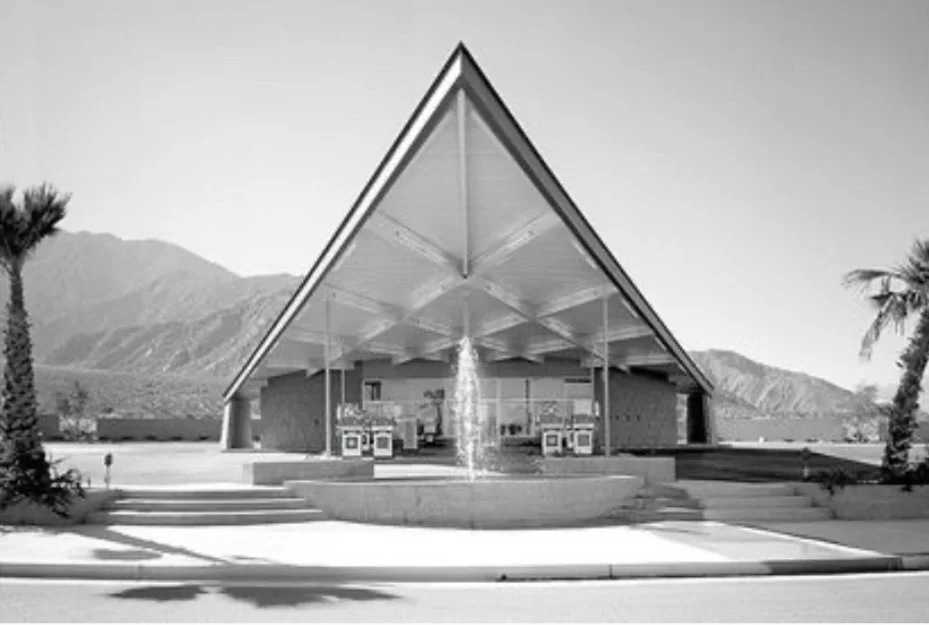
Service station designed by Albert Frey
Out With the Old and In With the New
Palm Springs is a time capsule of Mid-Century Modern architecture, the greatest concentration of this style in the world. It was an optimistic time when space exploration and technological advances made us feel like everything was possible and life could only get better. “Out with the old and in with the new” was a catchphrase. Black and white, and then color television, HiFi, then stereo, sleek American-made cars with tail fins (the models updated every fall), automatic dishwashers and air conditioning. Advertising touted all the “new modern conveniences” and “time-saving devices.”
New design ideas were expressed in architecture, art, film and fashion. Bright happy colors and bold geometric shapes were in vogue. Mid-century architecture was grounded in these forward-looking ideas and hopeful emotions.
Today, when entering our Palm Springs modernist neighborhoods, you can immediately experience the shift, feeling your mood lift and sensing the buoyancy and optimism of that era, a time when we put men on the moon and it seemed the entire universe could be our oyster. Palm Springs has, against all odds, remarkably preserved that time for us to enjoy today.
Desert Modernism
Our local interpretation of Mid-Century Modern architecture, as adapted to our climate, is now called "Desert Modernism." It emerged as a bold departure from the Spanish Revival aesthetic that dominated California before World War II.
The shift began in earnest in the late 1940s when Palm Springs increasingly became the playground for the Hollywood elite. Architects found that the harsh sun and rugged terrain demanded a new kind of design, a Desert Modernism that used deep overhangs for shade and expansive glass walls with open floor plans that framed the mountain views and blurred the line between indoor and outdoor living.
These designers paid close attention to the interplay of bright desert light and shadow, creating dramatic ever-changing patterns through the use of soaring rooflines with clerestory windows, decorative concrete block walls and other forms of brise en soleil (French for “sun-breaker,” a general term identifying means by which air and light could flow through while blocking direct sun exposure).
The Pioneers of the Desert
A small group of visionary architects defined the city's iconic look, adapting high-concept Modernism for our unique desert climate:
Albert Frey: Known as the father of Desert Modernism, Frey integrated natural landscapes directly into his designs. His personal residence, Frey House II, perched on a hillside, features a massive boulder cutting through its glass-and-steel frame. The home is now owned by the Palm Springs Art Museum and is occassionally open for tour.
Richard Neutra: Neutra brought international fame to the region with the Kaufmann House (1946), which became a global symbol of modern luxury through the lens of photographers Julius Shulman and Slim Aarons.
E. Stewart Williams: For his first commission, Williams persuaded Frank Sinatra to reject a traditional Georgian style design with brick and white columns in favor of his sleek Palm Springs Desert Modern design. The home was built in 1947 and, helped establish the city's status as a modernist capital. Now on the National Register of Historic Places, the Sinatra home has been a source of inspiration and ideas for other local architects.
Donald Wexler: A pioneer of steel construction, Wexler designed durable, prefabricated homes that could withstand the desert heat, most notably the Steel Development Homes in North Palm Springs. He also designed significant Desert Modern homes for Hollywood stars, including Kirk Douglas and Dinah Shore.
Other architects included William Cody (e.g., the Spa and Del Marco Hotels and several country clubs), John Lautner (Arthur Elrod and Bob Hope residences) and A. Quincy Jones (Sunnylands Estate and Edward G. Robinson home).
From Elite Retreat to Modernism for the Masses
While early masterpieces were custom-built for celebrities like Sinatra, the style eventually reached the middle class through the Alexander Construction Company and a few other production builders. Starting in the 1950s, over 2,000 "Alexander Homes" were built in neighborhoods like Twin Palms, Vista las Palmas and Racquet Club Estates. Designed primarily by architect William Krisel, some of these homes featured his famous "butterfly roof" and allowed middle-class families to experience the modernist dream for a price of $19,500-$40,000.
Preserving the Legacy
After a period of neglect in the late 20th century, a resurgence of interest in the 1990s led to the creation of the Palm Springs Modern Committee and our now-famous Modernism Week event. We’ve also seen extensive restoration and renovation work in all of our historic neighborhoods. Today, landmarks like the Palm Springs Visitor Center—formerly a Tramway Road gas station designed by Albert Frey—greet visitors as a testament to the city's enduring "space-age" optimism.
On our Downtown and Uptown tours, we see fine examples of commercial and public buildings designed by this group of Desert Modern architects. We also show photos of their home designs located in the residential neighborhoods and give recommendations for tour opportunities to explore these neighborhoods, either on your own or as part of an organized guide-led group. These tours are an excellent complement to our Downtown and Uptown food tours, showcasing a different side of Palm Springs history.
Join Artisan Food Tours for a tour to learn, enjoy and experience more of this remarkable, truly unique oasis in the desert!