
Atomic Dreams & Coffee Shops: John Lautner, Googie Architecture and the Palm Springs State of Mind
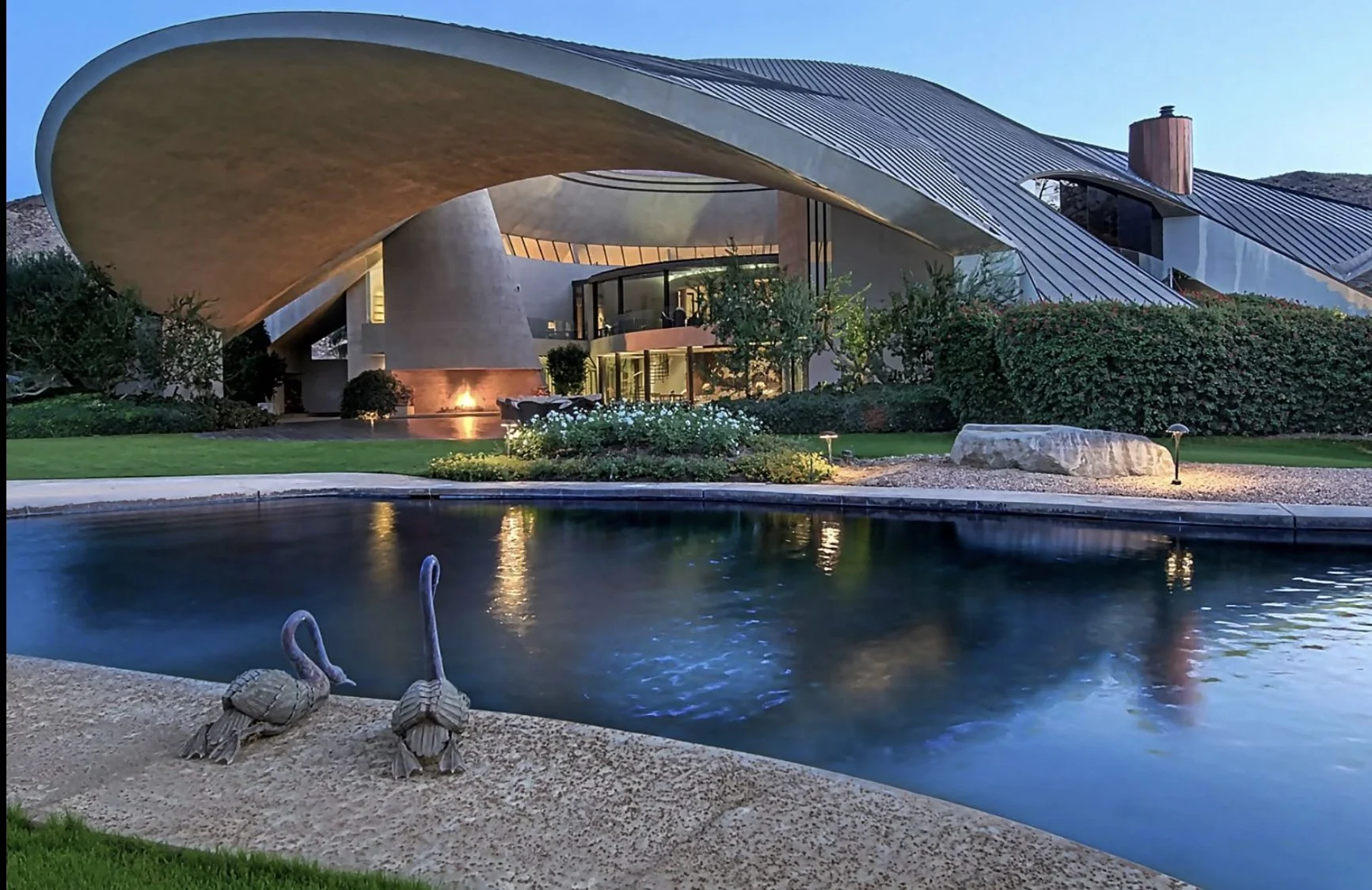
Bob Hope House in Palm Springs, designed by John Lautner.
There are cities that preserve history, and then there are cities that seem to have been designed for the future. Beginning in the mid-century era, Palm Springs belongs firmly in the second category.
Spend a day wandering its neighborhoods and you begin to notice something unusual: roofs tilt like jet wings, glass walls disappear into mountain views, and coffee shops look ready for a moon landing. It’s part Hollywood fantasy, part desert experiment and entirely irresistible.
At the center of this architectural fever dream sits one of Southern California’s most visionary architects: John Lautner.
If Frank Lloyd Wright taught architects to blend buildings into nature, Lautner turned that philosophy into something altogether more cinematic. His homes didn’t merely sit in the landscape — they exploded out of it. Concrete swooped. Angles defied gravity. Living rooms became observatories. Pools merged with horizons.
And nowhere does that spirit feel more alive than in and around Palm Springs.
The Desert as a Design Laboratory
By the 1950s and 60s, Palm Springs had become an unlikely playground for architectural experimentation. Hollywood stars escaped Los Angeles for weekends in the desert, bringing money, glamour and a taste for the futuristic. Architects arrived eager to test radical ideas under endless blue skies.
This was the age of optimism: the Space Race, tailfins, martinis and atomic-age confidence. Americans believed the future would be stylish — and preferably include a kidney-shaped pool.
The desert became a laboratory for that vision.
Flat planes and floor-to-ceiling glass made sense in the climate. Outdoor living wasn’t a luxury here; it was a way of life. Architects blurred the line between inside and outside long before “indoor-outdoor living” became every real estate agent’s favorite line.
John Lautner understood this.
Though many of his most famous homes sit in Los Angeles, his influence hangs heavily over the Coachella Valley. His work embodied the same daring optimism that shaped Palm Springs modernism: dramatic geometry, emotional spaces and an unapologetic embrace of spectacle.
Lautner designed buildings that made people feel something. Awe, mostly.
Enter Googie: Architecture Goes Full Space Age
To understand Palm Springs, you also have to understand Googie architecture — perhaps the only architectural style that sounds like it could come with fries and a milkshake.
Googie emerged in postwar Southern California and celebrated all things futuristic. Named after a now-legendary Lautner-designed Los Angeles coffee shop called Googie’s, the style embraced boomerang shapes, neon signs, sharp angles, starbursts, and dramatic cantilevers. It was architecture designed to catch the eye of drivers speeding by in convertibles.
In other words: subtlety was not the point.
Coffee shops, motels, gas stations, and diners became miniature monuments to America’s techno-utopian dreams. Buildings looked like satellites and flying saucers. Googie inspired the Hanna-Barbara studio’s designs for the Jetsons cartoon show (cartoonist Joe Barbara owned a Palm Springs home still in the family today). Every structure seemed to announce, “The future is going to be incredible.”
The style spread across the country. Remember when McDonalds had the big golden arches? Googie architecture.
Palm Springs adopted Googie with enthusiasm because the city itself already felt slightly unreal — a glamorous oasis built in the middle of the desert. The style fit perfectly.
Even today, you can spot echoes of Googie all over town: upswept rooflines, angular signage and retro neon glowing against the mountains at dusk.
It’s impossible not to smile at it.
Architecture You Can Taste
What makes Palm Springs especially fascinating is that its architectural history isn’t locked away in museums. You experience it while ordering tacos, sipping cocktails, or grabbing a date shake.
The city’s restaurants, cocktail lounges, and vintage motels still carry the DNA of midcentury optimism. Dining here feels theatrical in the best possible way. A meal becomes part of the landscape, part of the story.
You’re not just eating dinner — you’re inhabiting an era.
That’s one reason architectural tours and food tours pair so naturally in Palm Springs. Both ask visitors to slow down and notice details: the curve of a roofline, the glow of a neon sign, the way citrus trees frame a courtyard patio at sunset.
Design shapes appetite more than we realize. First, we eat with our eyes.
Why Lautner Still Matters
John Lautner’s work remains startling because it refuses to feel nostalgic. His buildings still look futuristic decades later.
That’s rare.
Many midcentury structures now feel charmingly retro. Lautner’s best work feels timeless because he designed emotionally, not stylistically. He cared less about trends and more about creating unforgettable experiences within spaces.
That same spirit continues to define Palm Springs today.
The city has evolved into a living archive of American optimism — a place where architecture still believes in glamour, where restaurants embrace atmosphere, and where even a roadside coffee shop can feel like a small work of art.
In Palm Springs, design isn’t background scenery.
It’s part of the meal.
And perhaps that’s the real legacy of Googie and Lautner: they remind us that everyday experiences — dining, driving, gathering with friends — can still feel imaginative, playful, and a little bit extraordinary.
Which, frankly, sounds like a pretty good philosophy for both architecture and travel.
Join us at Artisan Food Tours for one of our small-group food tours in Palm Springs with our five-star expert guide. We’ll visit some of the best restaurants and shops in town, including some with Michelin recommendations and connections. We’ll share fabulous food and delicious drinks, including wine and cocktails and you’ll hear all the juicy stories! Come join us on the best Palm Springs food tour.
Our fall season begins October 2nd but you can reserve your spot now at Artisan Food Tours. Cheers and bon appetit!